Sunday, June 20, 2010

More on transport values

The recent posts on the transit hierarchy of needs, and numerous other posts on the same subject around the blogosphere, have led some to (informally) catalog the needs that transport users have.  By "transport", of course, I refer to all modes of personal transportation--transit, driving, bicycling, walking, or combinations thereof.

In a followup post on his blog, Cap'n Transit reduced the various factors enumerated in the University of Florida study which prompted the whole discussion, into four broad categories:  availability, value, amenities, and glamour.   In this post, I do the opposite--drilling down into quite a few more specifics, even beyond the original paper--resulting in a list of over twenty separate values.  I sort the specific values into the Cap's four toplevel categories, as they are extremely useful.  My interpretation of the four toplevel categories may disagree with the Cap'n in a few areas.

It should be noted that I am not, in this post, discussing or proposing any hierarchy or ranking of these values--different stakeholders invariably will consider different factors to be more important.  I'll reconsider this question in a followup post; for now, though, a simple catalog of transport values will be used.

Availability

Availability deals with the question of whether or not a given mode or service can reasonably be used at all for a given trip.  As mentioned in the initial post, one cannot use TriMet to reach Mount Hood; the bus doesn't go there.  (One can use transit in Portland to reach ski shuttles, on the other hand, so TriMet may well be part of a trip to the mountain). 

Values subordinate to availability include:
  • Geographic coverage is the areas that the service reaches (in a fairly broad sense).  If the nearest bus stop is down the street, the service is available; if it's 50 miles away, it's not.  The maximum acceptable distance for a service to be available varies based on quite a bit of factors--how long/far someone is willing to walk, whether or not biking or driving is an option, etc.
  • Temporal coverage has to do with what hours of the day, and days of the week, the system or route is normally operational.  Does it run 24/7?  Daylight hours only?  Rush hour only?  Weekends and holidays?   Many routes, services, and systems operate only during rush hour on weekdays; a key advantage of automobiles is that for most motorists, their car is available 24/7.  A specific concern for many planned trips is whether or not the system will be available for the return journey. 
  • Capacity, here refers to the likelihood that the service will be unavailable due to being full.  If the bus stops outside my house, but is consistently crushloaded, that negatively impacts availability.  Likewise, if a motorist needs to haul an entire soccer team to a match, a Honda Civic will lack the capacity to do the job.  A related issue is the ability to bring baggage or freight with you--can you bring a purse or briefcase?  A week's worth of groceries?  A yard of barkdust?

  • Special accommodations/restrictions refers to how usable the system or mode is for those with special needs--the disabled, the elderly, those with small children, etc.  Likewise, if someone is excluded from a system or mode, for legitimate reasons or otherwise, the system is not available to them.  (A person with a suspended drivers' license, for instance, does not have driving legally available to them).  


    Value

    Value has to do with the overall quality and costs of the service, fcusing on  factors that might make a mode objectively unsuitable for a given purpose.  Value includes factors that any reasonable user might take into account, and aren't dependent on personal taste or preference.  Imporant value-based factors include cost, timeliness, and safety.

    Cost considers how much needs to be paid to utilize the mode:  
      • Marginal costs are additional costs incurred for an additional trip--things like fares, parking fees at destinations, tolls, fuel, and amortized maintenance.
      • Access costs refer to fixed costs that must be paid to have access to the mode, but generally don't rise with additional usage.  Examples include the purchase price of a car or bike, license and insurance fees, parking charges at your primary residence.  (Note that many transit agencies permit conversion of marginal costs to access costs via the sale of monthly or yearly passes).
      • Externalized costs are those costs which are borne by society at large, rather than by users specifically.  These costs can include things which are captured and levied as taxes, as well as uncaptured externalities such as pollution, roadway damage, congestion, disruption of communities caused by the presence of infrastructure, etc.
        Timeliness refers to the ability of a mode to permit completion of a trip in a reasonable amount of time.
          • Reliability refers to how often a mode meets its service commitments (availability, schedule, headway, etc)--can the service be depended on?  This includes delays and disruptions caused by any factor, regardless of who (if anybody) is at fault.
          • Trip time refers to how quickly one can get from origin to destination--the entire journey is considered, not just in-vehicle time.
          • Frequency refers to how often the service passes by an origin or destination--an important consideration for spur-of-the-moment trips or for when a scheduled departure is missed.
            Safety refers to the risk of casualties such as loss/damage to property,injury, or death--to users of the system, operators, and the general public.
              • Risk of accidents refers to the risk of casualty due to an accident (regardless of fault).  Are operators or drivers well-trained?  Systems, vehicles, and infrastructure kept in good repair? Is the right-of-way shared with other operators who might be reckless?
              • Risk of crime refers to the risk of casualty due to a criminal act on ones journey, such as being mugged at a bus stop, or being run off the road by an enraged motorist.  Is there an adequate law enforcement/security presence?  Are the rules enforced?  
                One final note on cost: Sharp-eyed readers may notice that the above discussion treats the purchase price of an automobile as a fixed "access" cost--you can't drive to work unless you have a car, and cars cost money.  This is contrary to the treatment of car-buying found in many publications (and endorsed by the tax authorities in the United States).  Many analyses instead treat the purchase of an automobile as a capital expense, and amortize depreciation based  on the usage of the vehicle.  The IRS, in particular, will permit qualifying motorists to deduct US $0.50 per mile from their taxes--an amount which includes a significant depreciation allowance.  I treat the purchase of a car as a fixed cost for the following reasons:
                • Many motorists are able to avoid the cost of depreciation by purchasing used cars, or driving cars beyond their asset life.
                • Nonwithstanding the above, cars experience significant depreciation in value simply by being parked in the garage; a car's age is every bit as important as its mileage or condition in determining its value.   (Many other durable goods don't have this property).
                • Many motorists don't view depreciation as an expense that is borne as they drive.  A more common viewpoint is to view the purchase of an automobile as a large up-front expense (even if the purchase is financed), and which isn't amortized over mileage.  Motorists who are entitled to deduct miles driven on their personal autos from their income taxes frequently view the deduction as a windfall; as the US$0.50/mile figure well exceeds the perceived marginal costs of driving, which for many, is limited to things such as fuel, parking, and tolls.  
                I'm not arguing that this treatment of automobile expenses is correct; simply that it accurately reflects the behavior of many motorists.  A common justification for rejecting transit use among many drivers is noting that the fare for their local transit system often exceeds the value determined by multiplying fuel prices times commute distance and dividng by gas mileage--an accounting which may be flawed in numerous respects, but is commonplace nonetheless.

                Amenities

                Amenities refer to tangible things which make the system or mode more or less present, but aren't likely to make it outright unsuitable for a given journey.
                Unlike the "value" factors, which are more universal in nature, reasonable users are more likely to disagree on the importance of these factors.  Convenience, comfort, and other enhancements, are all examples of amenities.  Note that here,
                convenience refers to the overall ease of using a system, or conversely, the hassles encountered.  (Jarrett Walker cautions against this word in its more generic--and ambiguous--usage; however it is given a more specific meaning in this post).
                  • Ease of use refers to any special skills or abilities needed to use the system (but which can be acquired by most persons).  Must one acquire a drivers' license or insurance?  Be physically fit?   
                  • System understandability refers to the ease of navigating the system--route planning, way-finding en route, the ability of users to have up-to-date information on service disruptions, arrival times, etc.
                  • Ease of payment refers to hassles involved with collection of fares, tolls, or other charges, and the enforcement thereof.  Are passes available?  Smartcards or stored-value cards?  Must one carry exact change?   Must one equip one's vehicle with a transponder to pass by tollbooths?  Must one carry proof of payment or other documentation?
                  • Integration with community refers to the hassles involved with getting to or out of the system.  Is there adequate parking at a destination for motorists?  Does getting to/from a platform require a long or dangerous walk?  
                  • En-route hassles refer to other issues encountered, such as the need to actually operate the vehicle rather than being a passenger;  the need to transfer, etc.
                    • Comfort refers to whether or not the system is physically pleasant or unpleasant to use.  Comfort excludes safety issues, but includes numerous questions such as sitting-vs-standing, ride quality, seat quality, creature comforts such as climate control, station/platform issues (indoor vs outdoor), privacy, the need for physical exertion, etc. 
                    • Other enhancements refer to other tangible things which might add value to users of a particular mode--WiFi access, food and beverage service, onboard media (radio, television),  
                    Glamour

                    Glamour includes non-tangible issues which may affect mode choice such as personal fulfillment, social status, etc.  Some people disregard glamour issues entirely, others choose to take retired tennis pro Andre Agassi's advice to heart.
                    • Aesthetic/novelty issues include things such as scenery en route, the architecture of system infrastructure (bridges, stations), artwork at stations, zoom and whoosh, the perceived high-tech or vintage nature of a system, the joy of driving that some experience, etc.  Novelty issues, in particular, are mainly important for tourists and persons trying a system or mode for the first time--nothing which is experienced every day will remain novel for very long.
                    • Status issues include attitudes towards other users of the system or mode, such as the avoidance of those considered unattractive, unpleasant, or undesirable (excluding legitimate safety issues); social status or acceptiblity of the mode (is it considered an elite mode of travel, or a mode of last resort), etc. 
                    • Self-actualization issues include other reasons which might affect mode choice.  These include the desire to: benefit or protect the environment, support the transit system or its workforce, show solidarity with a community, get exercise, or perform other good works.

                      Friday, June 18, 2010

                      Portland/Eugene HSR inches forward

                      The Pacific Northwest "Cascadia" corridor is one of ten proposed high speed rail (HSR) corridors in the United States proposed for development in the next couple of decades.  Most of the action in the development has been in Washington State--in particular the Portland/Seattle stretch; where WSDOT has been doing a lot of planning already--and where the rail infrastructure is in better shape than in Oregon.  (The BNSF mainline north out of the Couv is mostly double-tracked all the way up to Seattle).

                      Which way to go?

                      HSR in Oregon is a lot further behind the curve; but ODOT is starting to make progress on the issue.  (Not that they haven't been studying it for decades...) One of the first orders of business is selection of a route--and the two leading contenders are the UPRR mainline (through Oregon City), on which Amtrak presently runs; and the Oregon Electric line through  Wilsonville (WES presently runs on the Tualatin-Wilsonville stretch of this line), connecting to the Newberg branch in Tualatin, and heading through Lake Oswego to Willsburg Junction north of Milwaukie, where it would join the UPRR mainline.

                      (Map courtesy ODOT)

                      Next week, ODOT is holding a community meeting in Lake Oswego, to bounce the idea off the residents there.  Unsurprisingly, the idea isn't receiving a warm reception--community activists are already lining up to oppose the idea, and citing all manner of NIMBY reasons for not wanting the line.  (The line would not stop in Lake Oswego, merely pass through--it would have a stop in Tualatin).   In addition, the Association of Oregon Rail Transit Advocates (AORTA), is opposed to using the OE line. 

                      One other ideas which have been floated but not subject to serious study, a new HSR route running along (or in the median of) Interstate 5.  One idea I've proposed (but it's just an idea, so don't take it too seriously at this point), would be a connection between Hubbard and Wilsonville roughly along OR551, allowing trains to use the more mature UPRR line in through the Willamette Valley, where the route is unconstrained, and the switch to the OE/LO route in the Portland area, avoiding the Oregon City bottleneck.

                      Details, details
                      According to ODOT studies, improving the OE line to support HSR (which would only run at high speeds in rural areas) would cost $856 million, versus $1.27 billion for the UPRR mainline, and would shave 40 minutes off the trip time.

                      (Image courtesy ODOT)

                      Both lines would need extensive work to support HSR (and the HSR being discussed is pretty slow compared to what is commonly found in Europe and Asia--but I suppose crawling needs to come before walking).  Both lines are mostly single-tracked with sidings; and the UPRR line (currently FRA Class 4 for much of its length) runs into some serious geographical constraints in the Canby-Oregon City area, where it is sandwiched between the Willamette River, OR99E, and the bluffs overlooking the river.  The OE line has generally FRA classes 1-3, and passes through some residential neighborhoods which would require bypassing in any case.  In addition, a new connection between the OE line and the Newberg branch in Tualatin would be required, as no connection can be presently made between the two lines without a switchback.

                      That said, the aforementioned 2009 ODOT study has attracted plenty of criticism from AORTA, suggesting that its cost estimates are groundless--noting in particular that many of the improvements to the UPRR mainline included in the estimate, UP will have to perform (and presumably pay for anyway).  I'm a bit perplexed at the harshness of the criticism from AORTA on this subject, to be honest.  On the other hand, I have a bit of a hunch that the OE proposal may be a negotiating ploy with Union Pacific, as the UP has a well-deserved reputation for playing hardball in discussions such as these. 

                      Final thoughts

                      I'll be honest:  I don't care which way HSR goes in Oregon.  The main action in the Cascadia Corridor is in Washington State; until Portland-Seattle trip time is improved, speeding up the Portland-Eugene route is probably doesn't yield much bang for buck.  My preference would be for more frequent commuter service in the Willamette Valley (particularly Portland-Salem) rather than HSR; that said, many of the improvements necessary to support HSR would also enable commuter rail.

                      One important prerequisite, though, has already occurred (though it hasn't yet taken effect).  In 2008, Congress passed the Railway Safety Enhancement Act of 2008, which mandates positive train control on the vast majority of the US rail network--when this is done, many of the onerous FRA buff strength restrictions (essentially requiring trains running on the freight network be built like tanks) will be scaled back--making passenger rail service (which pays a steep gas-mileage penalty due to the current regulations) more efficient.  The new requirements don't take place until 2015, but HSR in Oregon won't be in place until well after that. 

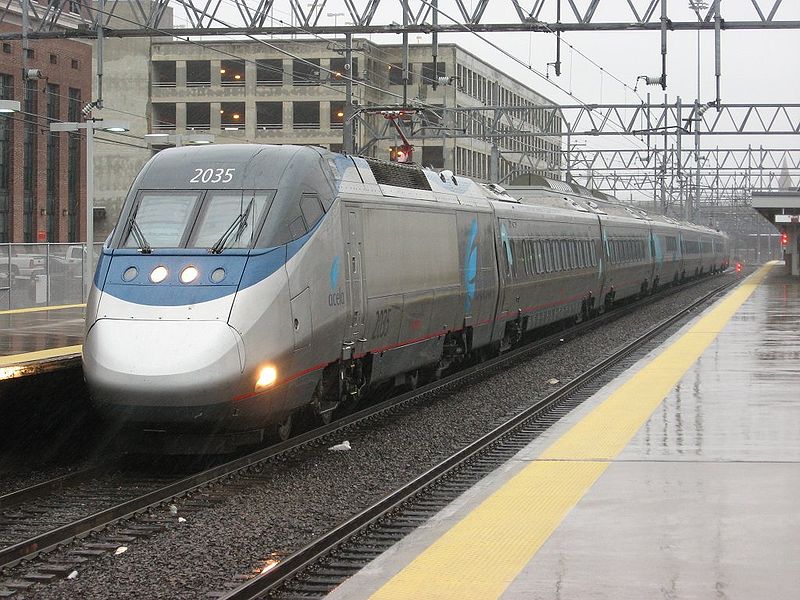
                      (Image courtesy Wikipedia)

                      Thursday, June 17, 2010

                      Bus rapid transit in Portland?

                      One of the interesting tidbits in the recently-published 2035 Regional Transportation Plan, courtesy of Metro, is the revelation that Bus Rapid Transit (BRT) is being considered for the Powell Boulevard rapid transit corridor. While there are other functioning BRT systems in the Pacific Northwest, including one in Eugene and one in Snohomish County north of Seattle; and Clark County has plans to implement BRT across the river, this would be the first BRT system to go online in Portland itself.

                      Portland has considered BRT in the past.  Back when the city's first rapid transit line was being planned; BRT was a strong contender.  Light rail was ultimately chosen, and now MAX is up to four lines, with another line scheduled to begin construction in 2011.  More recently, the Lake Oswego transit project considered a BRT solution as an alternative, though that was eventually scaled back to "enhanced bus" (frequent limited-stop service without any infrastructure improvements).  But for now, there isn't any BRT in Portland.

                      Or is there?  While there is nothing billed as bus rapid transit here in town, there are plenty of examples of "enhanced" bus infrastructure, both present and future.  There's the transit mall; numerous bus lanes and queue jump lanes scattered through town, and the on-the-drawing-board Caruthers Crossing, which will permit busses, light rail, and streetcar to all cross the Willamette River inconvenienced by auto traffic.  But do these things constitute BRT?


                      The controversy

                      BRT, of course, has been a source of controversy in the US.  Some transit advocates view BRT as a Trojan Horse, hawked by those who don't wish to spend the money to "do it right"--and some go far as to suggest that it's all a giant plot by the auto-petrochemical complex.  (The rail advocacy site lightrailnow.org is rather harsh in its assessment of BRT).  Others claim that its useful applications are limited, and note that in many cases, it consists of bus service made to look like rail--so why not build rail instead?  On the other side, depending on the level of service you need, you can often build much more BRT than rail for the same amount of money.  BRT has several specific advantages, including the ability to support trunk lines which operate on a dedicated busway and then branch off onto local surface streets (so-called "open BRT"); and the ability to use local streets to get around obstacles that it would be difficult or expensive to add a dedicated line for.  Two websites engaged in BRT advocacy are here and here.  Anyone interested in BRT would be advised to read this article.  (My own views on the subject have changed a bit, in large part to Jarrett's fine blog). 

                      What is bus rapid transit, anyway?

                      Good question.

                      The term "bus rapid transit" is, unfortunately, a bit of a buzzword.  BRT service can range from local bus lines with less frequent stops and minor enhancements such as signal priority, such as LA's Metro Rapid, all the way up to fully-grade-separated transit lines.  In addition, many services or routes which have BRT properties are not branded as such--so further investigation is in order.

                      The critical attributes of BRT is that it use busses (ya think?), and that it approximate, in some fashion, "rapid transit".  The term "rapid transit", itself ambiguous, implies some level of service performance which is superior to ordinary mixed-traffic bus service--generally in terms of speed, reliability, and frequency.  Mixed traffic bus service frequently has to make unscheduled stops (for traffic lights, blocked streets, etc)--all of which undermine both speed and reliability; and place operational constraints on frequency.  Thus, any system purporting to be "rapid transit" ought to take steps to avoid times when the bus has to stop for other traffic.  Ways to accomplish this include:
                      • Dedicated or enhanced street infrastructure.  This can include full-fledged busways (which may be grade-separated), dedicated bus lanes alongside auto traffic, queue jump lanes, transit malls, green bridges and underground transit tunnels, etc.    All of the "signature" BRT systems--Brisbane, Ottawa, Curitiba, Bogota--have extensive busway networks which segregate busses from other traffic.
                      • Bus priority arrangements.  This can be something as simple as laws requiring traffic to yield to busses pulling away from the curb (present in Oregon), to signal priority at intersections, to a proposal Barcelona is considering to use lane control devices to cause motorists to yield to busses like they would yield to an ambulance.  (No, the bus won't be running around town with sirens blaring).  
                      A second class of improvements is geared to reducing dwell time at scheduled stops, or at least making stop time more predictable:
                      • Use of fare collection schemes other than onboard fare collection (which can slow down loading).  Some BRT systems use proof-of-payment (the system used by MAX); a few fully-enclosed BRT systems can use barriers or turnstiles--a feature typically found on subway systems.  One other option is not collecting fares at all.  
                      • Use of specialized busses. This can include longer busses with greater numbers of doors--many BRT systems use 60' articulated busses rather than than the smaller 30' and 40' models typically employed for local service.  Some even have doors on both sides, and dual-sided platforms.  Use of larger busses also increases system  capacity; though such busses may have trouble navigating local streets (and in some cases may not be street-legal).
                      • Use of dedicated platforms which facilitate level boarding of wheelchairs and the like--the need to use mechanical lifts for boarding disabled passengers can slow things down tremendously.  Dedicated platforms are often necessary for off-board fare collection, unless fare machines are present on-board, or the system is to be limited to passholders.
                      And two other aspect of BRT which generally needes to be present:  longer stop spacing and frequent all-day service.  All the improvements to the route, the vehicles, and the platforms which you can think of aren't going to dramatically speed up a service that stops every 200 meters or so.  (Conversely, running limited-stop service on local streets is generally useless--the bus will still be frequently stopped for traffic and thus not be "rapid"--so it's better to increase the utility of the service for a small additional time penalty, and make it a local; an exception is express bus service running on highways).  And even a fast and reliable service is of limited use, particularly to those who have the option to drive, if it isn't frequent and available during the majority of the day.  (One reason which express bus--and commuter rail--are not replacements for rapid transit is that these services generally only run during peak commute hours).


                      Open vs closed?

                      Distinction is often made between "open" bus rapid transit and "closed" bus rapid transit.  In open systems, there is dedicated bus infrastructure which is used to speed up bus service, generally on some trunk lines.  Ordinary busses will run part of their routes on such infrastructure in limited-stop mode; running other parts of the route in mixed traffic.  In cities with a single important destination, such systems may work better than corridor-based systems such as rail or closed BRT.  Brisbane's BRT operates on this principle.   The primary disadvantage of open BRT is that it limits the ability to further speed up service with specialized rolling stock or optimized platforms or fare collection policies--as the busses also have to serve local routes where the necessary infrastructure for prepayment or dedicated platforms may not exist.

                      In closed systems, special bus lines run, entirely (or mostly) on dedicated infrastructure.  These systems tend to resemble rail more, as the bus line serves a particular corridor rather than branching out into the wider community.  Closed BRT has the advantage that it can be much more readily optimized for rapid transit applications--as the busses stay on the busway (or if they leave, only call on specific dedicated platforms), there's no need to worry about scaling up to thousands of roadside bus stops which may be no more than a signpost along the road somewhere.

                      It is entirely possible, of course, to mix the two types of BRT, including on the same infrastructure.  (It may not be possible to mix stops in this manner, but adjacent stops can serve on flavor or another).  Generally, in such a scheme, open BRT routes are branded in the same fashion as non-BRT; whereas closed BRT is branded differently--which leads us to the next topic.

                      Branding

                      One other common attributed of BRT is branding--how the service is presented to the user.  Many BRT systems are identified differently from ordinary bus service.  In some cases, they are branded in a similar fashion as a city's rail rapid transit (the LACMTA Orange Line and the MBTA Silver Line are two examples; both agencies use route colors for BRT, light rail, and heavy rail metro); or they may have an intermediate brand.  LA, for example, has two BRT systems (the Orange Line, a closed, dedicated-busway system, and the Metro Rapid service, a limited-stop service running in mixed traffic with signal priority); each is branded separately from each other and from ordinary bus service. 

                      Branding encompasses several things; including the visual design of the busses themselves; how routes are identified, the name of the service. etc.  It can be obvious--vastly different colorschemes and other fanfare; or subtle--attaching an "R" suffix to the route numbers of rapid routes, for instance.  Branding serves several purposes.  Most importantly, it distinguishes different varieties of service from each other--this is especially important if the different services have different fare collection policies, for instance.  Branding, and other cues (such as pricing and amenities) can also be used to signify that a given service is premium, in places where the social acceptability of transit is an issue (such as cities where "ordinary" bus service is seen as a refuge of the poor).  Branding also can serve political goals as well--a "new" bus line may be seen as more desirable to a political sponsor looking to feather his cap, than an extension to an existing service.

                      Branding isn't strictly necessary, of course.  An entirely open BRT system may do with no BRT-specific branding at all, and treat the infrastructure enhancements as simply parts of the urban fabric, of no particular import; if a bus runs on a busway, or not, it doesn't matter.  Closed BRT systems, especially when different policies are in force, generally need higher levels of branding--so passengers will e.g.  know whether they need to buy a ticket from a machine, or pay the driver at the door, in order to ride a particular bus.

                      The Portland situation

                      As noted in the lead section, Portland has quite a bit of dedicated bus (and rail) infrastructure in place.  The transit mall is the signature piece of Portland's bus infrastructure--a high-capacity downtown transitway which effortlessly delivers busses and MAX trains from Union Station to PSU.  There are plenty of other streets with bus lanes--82nd Avenue near Clackamas Town Center, Hawthorne and Madison, etc.  And the "Caruthers Crossing" will provide a near-dedicated bus connection between the the south end of the mall, and important Southeast destinations like Powell Boulevard and the center street bus depot. 

                      What is essentially missing is long corridors of enhanced bus infrastructure served by frequent, all-day, limited stop service.  While TriMet runs quite a few frequent services (even if "frequent service" isn't as frequent as it used to be) TriMet's bus lines are generally either locals or expresses. 

                      BRT on Powell

                      What would a Powell BRT look like?  A lot depends on the budget available, but the Caruthers Crossing would likely be an important part of it.  Between 12th and 39th, it would be difficult to provide dedicated bus lanes without spending a lot of money or doing a lot of violence to the existing neighborhood, so improvements may be limited to signal priority and additional queue jump lanes.  (Keep in mind that Powell--US 26--is an ODOT facility; so removing auto lanes is likely a non-starter).  East of 39th, there is more room to add dedicated bus lanes, as there is a wider median and the various stretches of frontage road (leftovers from the Mount Hood Freeway).  The intersection at SE 82nd (one of the busiest and most hazardous in the city) would provide challenges, as would the interchange with I-205 (and the nearby Green Line). 

                      East of the freeway is one of TriMet's bus depots, so enhanced bus infrastructure along the corridor could also help reduce the expenses associated with deadheading.  Powell is presently a 2-lane road between I-205 and SE 174th, then widens to 3-4 through lanes east of there.  Going to a full four lanes is probably necessary to support BRT.

                      What about elsewhere?

                      Where else in Portland might BRT make sense?  The Barbur corridor is one which might benefit from BRT as opposed to rail.  Like Powell, Barbur has excellent connections to the transit mall.  And whereas Powell is part of the eastside grid, and the #9 bus (the present local service) has numerous parallel routes; Barbur acts more like a trunk line, with numerous routes converging on it to head downtown.  The grades involved in climbing to Burlingame might be problematic for rail, especially in a dense-traffic environment.  If the goal is to provide rapid transit service to outer suburbs like Tualatin or Sherwood, light rail might be more appropriate than BRT due to the distance involved; but a light-rail line serving these communities could also run along OR217 and connect to the the Blue Line in Beaverton (which could also help deal with the WES problem).

                      A second place where BRT might be beneficial would be a connection between the CRC, when built, and downtown.  As mentioned in this post, I view rapid (or express) bus service to Vancouver as complimentary to the Yellow Line; given that Clark County plans to build BRT, making it easy to extend it into Portland is an obvious thing to do.

                      Other potential BRT corridors, pulled out of the air, include:
                      • TV Highway, possibly continuing into Portland via Beaverton/Hillsdale and Barbur
                      • The Hall Boulevard corridor--another WES alternative.
                      • A line reaching St. Johns
                      • Milwaukie/Clackamas or Milwaukie/Oregon City.  These may be better served with light rail, given the extension of MAX into Milwaukie, but BRT could make sense here as well.
                      • Along the downtown eastside, and across either the Broadway or Steel Bridges, completing a downtown "transit loop".
                      Some final thoughts


                      A common argument against BRT in the Portland context, and one I'm sure I've made before, is "we have MAX for rapid transit".  That argument, however, isn't really a good one--there are applications where BRT (especially those forms not involving full busways) might make more sense.  We have both streetcar and local bus service serving neighborhood access needs; and we have both commuter rail and express bus providing quick rides to work from far-flung suburbs.  So BRT makes sense, and it's good to see that TriMet appears to be taking it seriously as an option.  Where to put it, and what form it would take, obviously involves more thought than I've put into a blog posting, but it is something that definitely ought not be taken off the table.

                      Tuesday, June 15, 2010

                      Metro lobs a high hard one past TriMet's ear

                      The American past-time of baseball has numerous traditions associated with it, along with an extensive set of unwritten rules--the etiquette and ritual of the game.  And no aspect of the game is more central than the relationship between the pitcher and the batter, as the two duelists try to eke out every advantage over the other.  One technique many batters attempt to employ is crowding the plate--stepping beyond the batter's box by a couple of inches, encroaching upon the strike zone--thereby making borderline outside pitches hittable, and making it harder for the pitcher to throw balls inside.  And the common response of a pitcher to such encroachments is the brushback pitch--a high inside fastball designed to come uncomfortably close to the batter's head, and encourage him to retreat to the safety of the box.   Brushback pitches are different from beanballs--the pitcher is not trying to injure the batter, just intimidate him.  And if the pitcher is a feared fireballer--a Randy Johnson or a Nolan Ryan in their respective primes--the technique often works. 

                      And so it is in politics as well.  The political equivalent to chin music frequently is the open letter--a politely-but-sharply-worded missive written in letter form and sent to an elected official or policymaker--and simultaneously (or subsequently) published in order to make the intended recipient squirm.  Not all such letters have the desired effect--were a blogger such as myself to draft one, it would almost assuredly be ignored by the target--but if the sender has real power, an open letter can be intimidating indeed.

                      Which leads us to the open letter which Metro councilor Robert Liberty sent to TriMet last week, and which was posted on Metro's website today (as well as incorporated in the Metro-spam-stream for those who subscribe to it, such as yours truly).  It is reproduced here:


                      TriMet Board of Directors
                      4012 SE 17th Ave.
                      Portland, OR 97202
                      June 6, 2010

                      Dear President Van Beveren and members of the TriMet Board of Directors:

                      Congratulations on your recent hiring of Neil McFarlane as General Manager.

                      I have served on committees with Mr. McFarlane and found him competent, thoughtful and easy to work with. I look forward to working with him in his new role as General Manager McFarlane and expect him to be a capable leader of TriMet.

                      However, the process by which the Board selected a new General Manager concerns me.

                      Fred Hansen's retirement was announced on March 17. I expected Mr. Hansen's retirement to be used as an occasion to hold public hearings to solicit comments from the public regarding the opportunities and challenges facing the transit agency and how those opportunities and challenges should inform the choice of the next General Manager.

                      The hearings would have allowed the public to comment on very basic questions of strategy, such as trade-offs between capital and operating costs for light rail versus buses, how to extend transit services to the outer portions of the region, integrating land use and transportation investments, and the long-term financial health of the agency.

                      I expected the selection of a search committee that would draw on not just the TriMet Board and a few local officials but also prominent members of the regional community.

                      I expected an international search for a new General Manager, because our region and TriMet can attract talent from across the U.S., Canada and other countries. The culmination would be the public vetting of the finalists.
                      But that isn't what happened.

                      Three weeks after Fred Hansen announced his retirement, Metro President David Bragdon and I called the TriMet Board President to learn about the search process and to pass along the name of a potential candidate. I was amazed to hear that TriMet had already created a search committee, had narrowed the list of candidates to six to eight finalists, and that the list would be narrowed to three finalists within a matter of a week or two.

                      Mr. McFarlane's selection as General Manager was decided in late April and announced on May 4.

                      One of the greatest assets of this region is the large number of sophisticated and engaged citizens, from all parts of the region and all walks of life, who have important experience, professional expertise and good ideas about how we make our very good transit system even better. Many of these citizens or their businesses pay the taxes that support TriMet operations.

                      The Board missed an important opportunity to benefit from the knowledge of the citizens, customers and taxpayers in one of the most important, or perhaps the most important, decision it makes.

                      Like you, I hope that Mr. McFarlane has a long and successful tenure at TriMet and so there will be no opportunity in the near term to try a different approach to hiring the General Manager.

                      However, there will be many other opportunities in the future for TriMet to benefit from engaging our thoughtful citizenry in the important issues about our regional transit system. I hope the Board will seize those opportunities.

                      Despite my disagreement with the Board about the hiring process, I also would like you to know that I appreciate your service as community volunteers.

                      Respectfully,

                      Robert Liberty
                      Whoosh! 

                      Ball one, hollers the ump as the batter gets off the ground.

                      Metro had previously made its displeasure known about the shortened (and secretive) hiring process, one in which The Oregonian manage to report that someone else, rather than Mr. McFarlane, had gotten the gig.   So this letter, published right in the middle of McFarlane's transition period (he takes over full-time on July 1), seems to be a calculated warning shot.

                      And it's one with teeth.  Metro, after all, has the statutory power to take over TriMet, whose board of directors presently serves at the pleasure of the Governor.  Metro so far hasn't explicitly threatened to use this power--and perhaps the running of the beleaguered transit agency is one additional iron that Metro would rather not have in its fire.  But the way TriMet conducted its search seemed to annoy just about every other local government in town--but it's Metro who is standing on the mound, armed with a 95MPH fastball.

                      Saturday, June 12, 2010

                      While we wait for the USA-England world cup match to begin...

                      A quick quiz:

                      Which of these urban transport vehicles is a cable car, and which is a tram?


                      (Images courtesy of Wikipedia)

                      Chances are, if you live in an English-speaking country which drives on the right--particularly the United States, you'll be familiar with the San Francisco Cable Cars, and identify the image on the left as such.  You may be less familiar with the Portland Aerial Tram--unless you live in Portland, it isn't exactly a well-known landmark--but the term "tram", to Yankee ears, refers to any number of miscellaneous (and relatively uncommon) people-movers, including the custom-built inter-terminal railways found at airports, the centipede-like parking lot shuttles found at Disneyland, and to cable-hauled aerial gondola systems like found between Marquam Hill and South Waterfront.  Likewise, Americans generally use the term cable car to refer to cable-hauled railways. 

                      If you live in merry ol' blighty, on the other hand, a "tram" is what in the US is called a "streetcar"--a passenger railway or railcar which runs in or near the street (or which is capable of doing so), regardless of haulage.  And given that cable-hauled railways are actually pretty rare; the term "cable car" generally refers to cable-hauled aerial systems in the UK (see the aforementioned article for a good breakdown of the terminology).  Thus--a Brit may well describe the Portland Aerial Tram as a "cable car", and the San Francisco Cable Cars as "trams".  And he'd be correct, insofar as his dialect of English is concerned...

                      Confused?  So am I. 

                      Now enough silly linguistic arguments.  It's almost time for soccer.  I mean football....

                      Friday, June 11, 2010

                      News from Metro, more on federal financing, and an ingenious parking solution.

                      A few tidbits for a Friday evening, prior to the War of 2010 commencing tomorrow morning.

                      Metro had two pieces of big news this week.  The first is the release of the 2035 Transportation Plan Update, which you can read here.   I'm still digesting it, and will probably have more comments on it in the future--at nearly 500 pages, it isn't exactly light reading....

                      The second is the announcements that the urban and rural reserves designations for the forthcoming decades were finalized.  The preliminary designations were published in March, and the final designations announced this week are mainly tweaks.. however, Washington County's Peterkort family apparently got their wish:  A large tract of land north of PCC Rock Creek, not specified as urban reserve in the preliminary map, is specified as such in the final map. 

                      In other news, a Save Our Ride transit rally was held downtown at Director Park, lamenting recent TriMet service cuts.  Amalgamated Transit Union Local 757 (which represent TriMet operators) was there, as was John Kitzhaber, the Democratic candidate for governor (and two-term former gov, who must relish the thought of governing the state with a friendly Legislature).  The theme of the rally seemed to be "Congress, bail us out"--while that's not a bad idea, some of the more controversial ideas (such as mothballing rail projects) didn't get much play.

                      Speaking of federal funding, Yonah at the transport politic asks a good question:  Should the feds focus on operations, rather than on capital costs?  He makes a decent case--local funding of these often makes it rational for local politicians to cut transit funding (especially when the transit authority serves a single municipality, not an entire region).  And the Feds can more easily borrow money in lean times (whether they can save it in good times is the million dollar question), which would allow the stark service cuts seen 'round the country to be avoided.

                      And finally, the latest viral video making the rounds (Joseph Rose at Hard Drive posted it a few days ago, but my sister just sent it to me)--one way to get around no parking zones:


                      Maybe TriMet ought to set up a few portable bus lanes, and see if ODOT and/or the city public works department notices. :)

                      Have a nice weekend!

                      Wednesday, June 9, 2010

                      An inversion of the usual bus/rail assumptions?

                      On a thread at portlandtransport.com discussing the Columbia River Crossing, a controversial project to replace the Interstate Bridge between Portland, OR and Vancouver, WA, there was a rather interesting comment.  Like many of the threads on this subject over at that fine blog, this one turned to one of the key design features being debated: light rail.  The current $4 billion proposal, as well as numerous scaled-down proposals coming from the Portland side, all call for the MAX Yellow Line to be extended across the river into downtown Vancouver.  (The current proposal doesn't have MAX going very far into the Couv, which is far less densely populated--and more politically conservative--than the Oregon side; and the Southwest Washington Regional Transportation Council has selected BRT rather than rail for its future rapid transit backbone).  Many on the Vancouver side, frankly, don't care one whit about light rail and would just as soon that it stay in Oregon (though a recent survey may challenge that assumption).  There's a whole host of other nasty stereotypes and accusations being bandied about by activists on both sides, which I won't repeat here; about the only thing that is agreed on is that the $4 billion proposal, promoted by both states' departments of transportation, is unacceptable.

                      Commenter Anandakos, a Vancouver resident who is not an anti-transit shill by any means, had this to say:
                      I'm a 64 year old white guy I/T person who has short hair and showers daily. The middle aged women who are the majority of riders on the Clark County expresses are resentful when I or any other guy like me sits down next to them in an empty seat on the 199 or 105. They only want to sit with other women.
                      And you expect them to ride down Interstate Avenue with the boom boxes and winos? Get real and get a life! If their express buses are taken away they WILL drive to work.
                      Anandakos made several other technical arguments concerning MAX service to Vancouver which are not relevant here, go read the thread if you're interested (his comment is the first after the post).

                      The thing I wanted to highlight is that this is an inversion of the usual state of affairs in bus/rail debates.  Anandakos is positing the existence of a class of choice transit users--in the United States--who are willing to ride a bus line but would abandon transit were it replaced with rail.  Usually, it's assumed that choice riders--and the riders Anandakos describes are choice riders, as they have the option to drive--prefer rail to bus.  Here, it is being claimed that a group of riders prefer the bus.

                      The 199 and 105 lines which C-Tran (Vancouver's transit agency) runs between Vancouver and Portland, aren't just any busses.  They're express busses which spend the bulk of their time on Interstate 5, not stopping anywhere other than the Portland transit mall and a few transit centers in Vancouver.  Not only that, but they're state-of-the-art Gillig hybrids, with nice interiors more reminiscent of a motor coach--ample amounts of plush seating, personal lights, etc.   The following video, courtesy of punkrawker, demostrates the C-Tran express routes.


                      Not all busses in C-Tran's fleet are as nice; these vehicles are mainly found on the express routes.


                      MAX light rail, of course, is MAX.  The Yellow Line generally uses newer trains, but the on-board amenities are spartan, and during rush hour, many of the trains are standing-room only.  MAX generally doesn't get stuck in traffic (which can happen to the express busses), but the trains do stop fairly frequently, whereas the bus runs nonstop between Portland and Vancouver.  In addition, some of the neighborhoods which the Yellow Line passes through (and the C-Tran express pass) by are the sort which some suburban ladies may prefer to avoid.   I pass no judgment myself, of course, and it would be inaccurate to characterize the area as blighted (or worse)--but for those who live on in suburbia because they want to avoid interacting with others of different cultural backgrounds (ahem), a ride on the Yellow Line might be disconcerting.  Like it or not, for many commuters, not having to mingle with those they consider undesirable is a key driver of their transport mode choice.


                      At any rate, if Anandakos' anecdote is true, it just goes to show that the social acceptability (and perceived safety) of a transit line has to do with many more factors than what sort of wheels are underneath it.  The neighborhoods it calls on, and the amenities offered on board, have as much to do with it--even if one considers that steel wheels can enable a smoother ride than rubber tires on pothole-specked pavement.

                      [copyedited -- es]