Friday, August 13, 2010

Transit minimalism, and why the left and the right frequently come together to oppose rail

The Milwaukie MAX project, and its escalating costs and increasingly unstable funding, has become a prime target of criticism.  While I'm critical of quite a few particulars of the project (its cost, for one; it's routing, for another)--most of my criticisms center around particulars of the project itself and the current economic climate.  I think the corridor in question needs to have rapid transit of some form--by which I mean "real" rapid transit that runs mostly (if not completely) in an exclusive right-of-way.  Rail or bus is a secondary concern.

However, much of the criticism of the project goes well-beyond the details of Milwaukie MAX, and instead takes the form of an outright anti-rail position.  Several different identifiable factions have been advancing anti-rail positions, asserting that TriMet ought to cancel the project outright, and not advance any other rail projects for the foreseeable future.  (Occasionally one even sees the suggestion that the existing MAX lines ought to be dismantled and replaced with something else; a position I won't consider further).  Many of these factions have entirely different motivations and goals--in some cases, they even conflict--but their positions all lead them to the same conclusion.

The positions in question, and several others, were previously discussed in this post on transit agency missions; here we focus on only three.  Some of the criticisms discussed herein extend to other forms of rapid transit as well, such as BRT; others are rail-specific.

Social justice

One common set of light-rail critics are to be found in the community of activists desiring social and economic justice.   A prominent such organization in Portland is OPAL (Organizing People/Activating Leaders), which has, on numerous occasions, called for TriMet to halt future light rail constructions and instead provide more bus service.  OPAL's John Ostar, speaking to TriMet on the proposed property tax levy now on the November ballot, had this to say:


What we're doing – what you're doing, essentially, is requiring voters to pass bonds for absolutely essentially service, essential infrastructure, basic infrastructure. Things that we have payroll tax revenue to pay for. But instead, we're now using that payroll tax revenue to pay for non-essential service – light rail - and requiring voters to pass bond measures to pay for essential service. I think that we have it backwards.

Emphasis added by me.  Clearly, Ostar considers light rail to be a "non-essential" service--an interesting position to take given that 1/3 of unlinked trips are on MAX and not bus.  But when you consider what OPAL considers important, and what they do not, it makes perfect sense:
  • OPAL, and similar advocates, think that a key part of TriMet's mission ought to be providing transit to the "transit-dependent"--people who cannot afford an automobile, or who otherwise cannot drive.  Given that the transit-dependent (and their destinations) are often widely-dispersed in the region, that leads to service patterns which require coverage of a large area rather than focusing on a smaller corridor--a pattern of service that is easier to provide with busses (and in many cases, with paratransit).
  • Poverty advocates are generally less concerned with attracting "choice riders", providing extensive service to wealthier parts of town, increasing transit's mode share, or using transit as a land-use tool.  Amenities beyond basic coverage and service frequency/speed/reliability are deemed unimportant.  They are especially  wary of anything that looks or smells like gentrification--almost always a bad thing if you're poor.  (Your neighborhood might improve, but you won't be able to afford it anymore).  Many of the stated goals of rapid transit--especially rail--are simply unimportant to advocates to the poor, and some are viewed with hostility.
  • Many poverty advocates are generally distrustful of government--which is often seen as in the hands of the wealthy and powerful, and inherently indifferent (or hostile) to the interests of the disadvantaged.   Such advocates, when a large project is proposed by the government, frequently start to smell a rat.
In a world with unlimited funding (or at least in one in which comprehensive, quality bus service is provided), I suspect that capital-intensive projects would not raise much objections among the social justice community--especially if the projects were demonstrated to improve service in ways that were considered important--but in a limited funding environment, any concentration of resources on a particular corridor is problematic--especially if the result of such concentration is higher rents along the line.

Economic conservatives

A second group who can be counted on to oppose capital transit projects are what I'll call "economic conservatives"--a group which includes libertarians, many Republicans, and a broader spectrum of the population that objects to high(er) taxes for services they consider to be wasteful or non-essential.  Motivations can range from ideological ("transit shouldn't be provided by the government"), to financial ("I don't want to pay for transit I don't intend to use"), to skepticism concerning particular agencies ("Sam Adams/TriMet/Metro are all crooks"), to hostility toward the community of transit users ("Those damn hippies ought to get a job and buy a car like the rest of us").  This community also includes a fair amount of lobbyists for industries (auto, petrochemical) which frequently regard transit as competition.  With the financial crisis and economic downturn, calls for greater fiscal austerity ("light rail is a luxury we can't afford") get added to the mix. 
The overriding concern for this group is that dedicated-ROW rapid transit, particularly rail, is too expensive.  While some in this group would eliminate public transit altogether, there is a significant faction that supports what I call "subsistence transit"--transit that provides basic mobility to those who have no other choice, but of a quality which is so low that only the desperate (or dedicated) would use it.  Almost invariably, this means POBS ("plain old bus service"), usually running at low frequencies--virtually any capital improvement to the system or attempt to provide frequent service (other than in places and times where the busses are crowded otherwise) is, by definition, superfluous.  This may superficially appear to be similar to the social justice position--which also isn't interested in expansive service--but differs in several important ways.  Where as the social justice advocate generally wants to provide decent transit to the communities s/he represents, those supporting subsistence transit generally care first and foremost about cost.
While some conservatives do generally care about (and will defend) basic levels of transit service; there are others who want to do away with it altogether--and frequently use the characteristics of "social service" transit to attack transit.  Social service transit is inefficient by its nature (the busses are often empty); and that is used to advance arguments that the transit agency is incompetent (otherwise the busses would be full!), or that transit is not environmentally friendly (an empty bus is less fuel-efficient than a single-occupant automobile, after all), or that it's wasteful because hardly anyone uses it (which is, after all, the point).
Conservatives are also frequently skeptical about politics and government in general--especially in large cities, where the political scene is often dominated by liberals.  Charges that rapid transit projects are exercises in "social engineering", or represent forthcoming Soviet-style totalitarianism, or are intended to enrich labor unions, are common.

Speaking of unions...

A third constituency which is often hostile to rapid transit, especially rail, is transit unions--and the reason is obvious:  Jobs.  The biggest operating cost for transit agencies is labor; and one of the selling points of rapid transit--especially rail--is that you can provide the same capacity and service levels with fewer payroll hours.  While this can mean increases in service without corresponding increases in labor cost, in practice it often means reductions in hours, or layoffs.  And while some transit agencies (such as Muni in San Francisco) are notoriously labor-friendly, in most cases, the agency and its workforce have a relationship that is at least somewhat antagonistic.

What do these all have in common?

What do these positions have in common?  Several things:
  • A belief that the specific benefits provided by rapid transit are unimportant, and thus not worth spending money on.
  • A desire for transit minimalism--lack of interest in increasing ridership or service beyond some baseline level which is held to be "good enough"; in particular, a lack of interest in attracting "choice riders" to the system.
  • A lack of confidence in transit management/governance, often causing disbelief in the stated goals of the project(s) in question, and/or the projections concerning population growth, future ridership demands, and future revenue used to justify such projects.  In many cases, this is expressed as a public officials are acting in bad faith.
Of course, the different groups have lots of things which are not in common--fundamentally, social justice advocates are interested in service quality; conservatives in minimizing public costs; and labor advocates in maintaining payrolls and jobs.  These things are all somewhat in conflict--if you reduce the budget, you either have to slash service (and hours) or wages.  Increase wages, and either revenue must increase or service must be cut.  And increasing service requires either new revenue, or wage concessions. But in all cases, there is a fear that if money is diverted from the taxpayers, or existing uses, to fund new capital construction--that there won't be any return on that investment or expenditure.   And driving that fear, in many cases, is a lack of trust in the transit agency.

When someone makes a statement that light rail is not an "essential service", or that it is "anti-transit"--it is good to ask of them what their vision for the transit system is.  Chances are, their vision is one of minimalism--they believe that transit has a limited (and specific) role to play in the overall economy and infrastructure of a place, and that attempts at expansion are out of line.

A few final thoughts

Many transit activists, including yours truly, don't subscribe to the minimalist philosophy.  After all, we (as a society) haven't practiced minimalism when it comes to road-building over the past century--there's scarcely a capacity problem on the roads that doesn't provoke calls to build more of them.  And the result is a mess--and will become a larger mess the next time gas heads north of $4 a gallon.  I'm not a maximalist, either--I'm fully cognizant of the political and financial constraints which are in place, and believe that projects need to undergo public scrutiny.

However, the absolutist positions expressed by some, are extensively troubling.  They're political arguments couched as technical arguments.  (This is true for light-rail supporters as well).  It's far more open and honest to say things such as "I think TriMet should focus on social service to the poor, and not on trying to attract motorists from their cars", rather than attacking a particular mode choice as unsound.  It's better to have an open debate about values--what sort of service should be provided, then cloud that debate in pissing matches about bus vs rail.  Because that's what the debate is really about.  Arguments about mode choice are really arguments about values, and the vast majority of participants in transit blogs (including myself) have only a superficial understanding about the limitations of various technologies--often colored by what TriMet (or whoever the local transit agency is) does in practice. 

Thursday, August 5, 2010

Transit and safety

Over at portlandtransport.com, a frequent poster who is a harsh TriMet critic posted a news item concerning a recent act of violence involving the MAX system.  Apparently, a pair of hoodlums were having a smoke at Gateway TC, when a TriMet employee and an off-duty deputy (who flashed a badge at 'em) told them to put it out.  They did, but got on the same southbound Green Line train as the deputy, and after the cop got off the train at Clackamas Town Center, the two men jumped him.  The attackers were quickly subdued and arrested, but the deputy suffered a few minor injuries.

The thread quickly turned into a heated debate about transit safety, or Why (Everyone Thinks) Transit Is Dangerous.  The incident is an isolated one, no civilians were injured, and the security personnel involved did their jobs.  Yet the attack was featured on no less than three different evening news programs, and prompted a few of the local anti-transit advocates to fan the "TriMet is unsafe" flames.  (Disclaimer:  Some of the content here was taken from my comments on that thread...I'm a sucker for a good heated debate).

Is TriMet dangerous?

The safety of TriMet has been in the news quite a bit.  There are two essential components of safety--risk of accidents, and risk of crime--and TriMet has attracted much bad press (some of it deserved) on both counts.  A series of high-profile attacks on the Eastside Blue Line a few years back prompted TriMet to install fare gates at some platforms (the system mainly runs on the proof-of-payment system; the fare gates are intended to keep thugs off the line under the theory that potential violent offenders are also likely fare-jumpers).  Recently, the Clackamas County Sheriff complained that crime had risen in the vicinity of Clackamas Town Center since the Green Line opened.  TriMet disputes these claims, and portlandtransport.com has been trying to get clarification on these claims--including information as to whether apprehended miscreants were (ab)using MAX, or whether the new park-and-ride is an attractive target for thieves, or whether this is just a result of increased traffic, increased law enforcement presence, or coincidence.  It's worth noting that the sheriff has publicly complained about tax-increment financing for the Milwaukie Line, so there's some evidence of a strained relationship between his department and TriMet.

TriMet has been fortunate in that it has not experienced any accidents resulting in serious injury to passengers in quite a while.  However, pedestrians and cyclists have not been as fortunate, and there have been several incidents in recent years of walkers and bikers being struck by busses and trains--in some cases, the fault of the operator, in others, the fault of the person struck.  After the April 2010 accident where a bus ran down five pedestrians in a crosswalk, killing two, the agency engaged in much navel-gazing, culminating with the appointment of a director of safety; who reports directly to the general manager.    

Or are standards too high?

Certainly, TriMet has had problems.  But are expectations too high for the agency (or conversely, too low for other forms of transport?

One common area of criticism from many critics is that the agency doesn't "do enough" to promote safety.  There are often calls for the agency to hire more security and more fare inspectors, to install fare gates on more of the system, or to even close stations in blighted areas.  Often, such calls come with the expectation that the cost of this will be borne by the agency and its passengers--not by additional tax increases beyond what the agency already receives--implying that the difference will need to be made up by lesser service, higher fares, or both.

But is this fair?  States, counties, and local governments in Oregon spend hundreds of millions, if not billions, on police officers (and other emergency responders) designated to traffic patrol--essentially, security services for roads and highways.  The Oregon State Police patrol division--which doesn't do anything but patrol the state highways of Oregon--has a budget of over $100 million.  The thirty-six county sheriffs and numerous municipal police departments in the state likewise devote considerable resources not to crime prevention or investigation, but to nabbing speeders and drunks and cleaning up accidents.  And virtually all of this police work is paid for out of the general fund.  There aren't suggestions that ODOT ought to pay for the OSP Patrol Division out of gas tax proceeds (in fact, OSP was funded by gas taxes in the past, but the law was changed twenty years ago).  Patrolling the highways and byways (and many other public speces) is generally assumed to be part of the job description of police--they just do it.  However, patrolling transit is treated by many law enforcement agencies like a budget-busting headache.

Of course, the "transit is dangerous" meme is an old one.  There are some places where public transit is (or was at one point) the exclusive province of the poor, and violent incidents on bus lines or subways are not uncommon.  Many people are uncomfortable travelling with other demographic groups, and this discomfort is often perceived as a safety issue.  Even in New York City, where busses and trains run every few minutes, you can get anywhere on transit, and driving is miserable--there are lots of residents who use taxis to get around.

A question of structure

But this debate poses an interesting question:  Why has there been complaints from law enforcement about servicing transit, when you don't hear the same complaints uttered about patrolling parks, highways, local streets and sidewalks, shopping malls, and other public (and quasi-public) places? 

Part of the issue might be one of structure.  There are several different arrangements by which public services (public works, police, fire, transit, schools, ports, utilities, etc.) can be provided by the government:
  • As a department within "general" government (a city, state, county, or national government agency)--where the head of the department in question reports to, and serves at the pleasure of, elected officials.
  • As a department within a larger general government, where the department head is him/herself an elected official; a common example in Oregon are county sheriffs.  
  • As a "special district", separate from any mainline government agency, where a board of directors is elected by the voters, and in turn hires a manager, approves budgets, etc.
  • As a commission, or similar arrangement, where an independent agency has directors which are appointed by an elected official.  Unlike department heads, who serve at the pleasure of their superiors in mainline government, the commissioners in such an arrangement are often appointed for fixed terms, and in many cases cannot be removed without due process (and generally not without cause).
Many public services can also be provided by the private sector; those arrangements aren't relevant to this post.

In a post at The Urbanophile, Aaron Renn mentioned an article concerning mergers among fire departments in the Midwest, and whether that would produce cost savings or not.  He concluded his remarks with this:

I’m generally all in favor of eliminating non-general purpose units of governments that aren’t controlled by elected officials of a real government that people actually care about (e.g., a city or county). But not for merger related savings, which don’t seem to exist. 

In a comment, he added the following:


I do dislike special districts that aren’t accountable. Indiana township government is a perfect example. Indiana townships are not general purpose governments. They provide only certain functions like poor relief and fire departments (mostly in rural areas). They are controlled by their own elected officials, who operate largely out of sight, out of mind with the public. Unsurprisingly, the trustees and boards who run them do so as if they were personal fiefs, often employing relatives, and giving themselves generous pay and benefits for almost no work. Center Township in Indianapolis, for example, which is entirely inside the city limits, has amassed a huge property portfolio and over $10 million in cash for no apparent purpose.

Schools are another interesting one. They are often a similar case. I support mayoral control of schools, generally.

This old school notion of Tocquevillian style government with a plethora of elected officials and a patchwork of jurisdictions is simply not relevant in the current era. For sure it doesn’t work, or get the benefits that Tocqueville saw from it today. I do happen to think there’s a loss there. For example, we’ve seen the rise of the political class versus the citizen government ideal of old. But we can’t roll back the clock, and today’s urban scale is very different from the past.

In general, my preference is for competent governance.  Muni is subordinate to the city of San Francisco, and the service their stinks in large part because city government is famously dysfunctional.  However, Renn has a point.  Many special districts are run by officials who are elected in noncompetitive elections that nobody cares about.

But another issue, that is relevant to this post--is that in Oregon, transit authorities are generally special districts (TriMet is run by a governor-appointed commission); whereas the police and public works are generally part of mainline government.  While Metro and other MPOs can help bridge differences; it often remains the case that public agencies which are not part of a common reporting structure will have different organizational missions and goals.  Communication may be deficient--as nobody is responsible for the intersection of the services provided.  They may compete with each for public resources, and in some cases, may actively try to undermine each other.  Such arguments may occur within mainline government of course, but when two departments are part of the same larger organization; there is a built-in means for resolving such disputes. 

This arrangement can have consequences beyond law enforcement complaining about the cost of patrolling transit.  Jarrett blogs about a recent event in Ottawa, wherein construction crews tore up a downtown stretch of the Ottawa Transitway, without informing the transit agency--resulting in a major disruption of bus service.  And many efforts to install BRT are routinely stymied by public works departments, who view signal priority for busses with hostility--understandable, as their organizational mission is often centered on efficiently moving cars.

Quick hits

  • Next Monday, leaders from various local, regional, and state governments will get together to vote on what design for the Columbia River Crossing to proceed with.  Metro and the City of Portland have jointly announced that they will vote for the 10-lane solution, initially striped for 8 lines if possible, with a separate connection to Hayden Island from Marine Drive (across the south channel), instead of an interchange on I-5.
  • TriMet bus driver Al Margulies, whose blogging activities prompted a rule change at the agency concerning what drivers can do while operating a bus, is shutting down his blog, apparently at the behest of TriMet management.  Al has long been a great source and great friend for the Dead Horse Times, I'll miss his online presence.  (And hope he keeps commenting here, at portlandtransport.com, and elsewhere...)

Sunday, August 1, 2010

Tax increment financning and transit

Last week, the web site portlandtransport.com posted a five-part series of an interview with new TriMet director Neal McFarlane.  The interview touched on numerous topics, but a significant portion of the video dealt with the current financing crisis at the agency (and at many other transit agencies, and state and local governments in general).  One of the more contentious topics was the use of tax increment financing to pay for improvements to transit infrastructure and service. 

The video included several people giving testimony at a TriMet board meeting, in opposition to the practice--including the sheriff of Clackamas County and the chief of Clackamas Fire District, whose territories are served by the MAX Green Line, and the planned Milwaukie extension.  Both of them complained that TIF, which has been used in the past to finance improvements to the transit system, was hampering the finances of their respective departments, by simultaneously creating new demands for service and depriving them of revenue with which to provide that service.  Also appearing in the video was conservative political activist Steve Schopp, who has engaged the producers of the video (and yours truly) in the comment threads at portlandtransport.

And while I disagree with much of what Steve has to say, on this issue he's got a valid point.

What is TIF?

Tax-increment financing (TIF) refers to a means of public financing whereby the portion of property taxes (or other taxes) collected on certain parcels of land, which goes to the general fund, is frozen--with the difference being used to finance capital projects designed to improve the value of said parcels (and bring about some public benefit as well).  Generally bonds are issued to finance the actual project, and the tax-increment is used to pay back the bonds until they are retired.  This is especially important for Oregon, where Ballot Measures 47/50 limit property tax increases to 3% per year; unless the property in question is , or the taxes are to service bonded indebtedness.  TIF seems simple enough, but it has a few issues, even when used "properly":

  • Inflation may not be accounted for--if baseline costs to provide government services are rising due to inflation, but the revenue provided is frozen, cuts to service may result.
  • Sometimes the new development may increase the need for government services, such as turning a brownfield into a dense mixed-use residential zone.  Brownfields seldom need service from the police or paramedics, whereas places where people live often do.
The graph to the side, apparently designed by local TriMet critic (and frequent portlandtransport.com commenter) Jim Karlock for an anti-urban-renewal article at bojack.org, demonstrates how it works.  Whether or not the section labelled "red ink" is truly red depends on how expenses grow or shrink; in a well-designed TIF the red ink is minimal or nonexistent.

When does TIF work?

TIF works best when the following conditions are met:
  • The improvements are largely specific to those parcels being tabbed for tax-increment financing. 
  • The improvements may decrease, or at least minimize the increase, the need for public expenditures
  • The resulting property value increases are of sufficient magnitude that the bonds can be paid of quickly, returning the full value of the tax base to the general fund.
A common use of TIF that meets these requirements is certain types of urban renewal; where blighted neighborhoods are rebuilt.  Urban renewal of this sort satisfies the conditions--specific lots are affected, the improvements are frequently substantial, and the elimination of blight and the related social pathologies may well reduce public expenses.  (This analysis ignores the effects of gentrification--in particular, the beneficiaries of such projects are often landlords and developers, not people who live there who may be forced out due to higher rents or taxes.  But that's another subject).

What about infrastructure?

What about public infrastructure, such as roads, bridges, or transit lines?  At a neighborhood level, TIF (or better yet, Local Improvement Districts, where specific local taxes are levied against a neighborhood to pay for improvements), it can work.  But for major regional infrastructure projects, such as freeways or MAX lines, not so much:

  • Many demands for service are not reduced, and may increase, if the improvements result in more people living in the area (or travelling through).
  • Such things are built on public rights-of-way (whether on easements or owned by the public outright), not on private lots subject to taxation--in other words, the directly affected land is off the tax rolls.  Instead, TIF depends on general increases in the value of nearby properties to work.
  • For large-ticket projects, the size of the TIF district needs to be also large; magnifying the risk to other government functions should the projected increases in value not materialize, or should inflation or other causes increase government expenses unrelated to the project, which must be met with a frozen tax base.
What's the best way to finance major infrastructure projects?  For large capital projects which are regional in scope--the traditional way (an explicit bond measure backed by a specific tax levy) is probably the cleanest way to do it--it doesn't affect existing services, it demonstrates political will to do the project, and it represents a stable source of revenue which makes lenders happy, lowering the cost of financing.

Voterphobia

Unfortunately, TriMet lost a measure in 1996.  Actually it was a statewide measure, Measure 32, that authorized using lottery funds to fund the N/S MAX project and numerous road projects elsewhere--one that was put before voters during the height of the Oregon tax revolt.  But it failed--and since then, TriMet seems terrified to go before the voters to raise money for capital projects (or to use existing bonding authority that it has used but has not exercised).  Instead, we get things like TIFs, bonding payroll tax revenues (the source of much of TriMet's operating budget), and the like to fund capital projects.

Some parting advice

A bit of advice to TriMet.  Your service area includes Portland.  A place which is highly transit-friendly.  The greater Portland metro area, excluding Vancouver, presently sends THREE Democrats to Congress.  I don't expect either Wu or Blumenauer to lose this November; Kurt Schrader is a bit more vulnerable, but the GOP has nominated yet another nutcase.  While the following advice might not fly during the current recession, what with everyone grabbing their wallets, I will nonetheless offer it:

Trust the voters.  The bulk of the populace supports transit, especially if you can convince them that you know what you are doing, and aren't just wasting taxpayer money on patronage projects.  Demonstrate some fiscal soundness, quit f---ing around with crazy financing schemes, grow a pair, and put a bond levy for Milwaukie MAX on the ballot.  Or better yet, put a levy for MLR, Barbur, and improvements for the WES corridor on the ballot, so all three counties get some cake.  Even better than that, put different proposals on the ballot (light rail, BRT) and let the people decide what quality of transit they are willing to pay for.  Or not.

But enough with the current "system" of scraping together funds from a zillion different sources to pay for major infrastructure projects.  It makes it look like TriMet and Metro are trying to hide something; it puts you in hock to a whole lot of folks who don't give a damn about quality transit, and when it results in service cuts, it alienates the demographic you can least afford to alienate--your current supporters. 

As stated previously, the appointment of a new GM is an opportunity, a chance to wipe the slate clean, and break from the past policies of the agency which have been met with much scorn. 

And after all--if you don't trust the voters, why the hell should they--should we-- trust you?

Tuesday, July 27, 2010

Federal funding fun and games

In a comment on the prior post about Milwaukie BRT, RA Fontes noted in the comments that...

Don't know if things will change, but Mr. McFarlane has so far been awfully positive in his comments about Milwaukie LRT---all the jobs and economic development, etc.

An open BRT seems to be a no-brainer for this corridor. Single-seat service from OC and all over Clackamas County with door-to-door trip times that LRT can't hope to match except in a very few showcase examples.

But who cares?
 My response was this:

If I were cynical, I might suspect that getting $750 million of Federal money into the local economy is actually part of the goal.  :)

Actually, I am a bit cynical.  I'm not suggesting that TriMet (or any other particular agency) is engaging in any unique skullduggery... but I'm becoming more and more convinced that the current funding system in the US--where the bulk of tax dollars go to the Great Sausage Factory in the Sky, only to be doled back to the states and local governments by a bureaucracy with more layers than a bushel of onions--is broken.

Other bloggers I know disagree with me on this point, for various reasons.  Uniform standards are a good thing, and on many issues the US Government is more enlightened than quite a few states.  (Even the Bush Administration was more enlightened on transit issues than a few states I can think of...).

But the current method of funding disconnects the source of the funding from the target--encouraging waste and games.   Local governments generally view Federal grants as "free" money--even though it is funded by taxes, receipt of such funds has nothing to do with an area's federal tax liability.  Projects aren't always funded based on technical merit--much ink has been spilled about Peter DeFazio's ability to send transportation earmarks are way.  And yes--it is possible that in extreme cases, projects are pursued not because of the value of the system that gets built, but because of the opportunity to pump outside dollars into the local economy.  While the stimulus affect of locally-funded projects is overrated (such things merely move money around, not add to the wealth of a region); the stimulus affect of $750 million being sent into town courtesy of Uncle Sam is definite and real.  And if the money doesn't come to Portland, it will go to some other region.

Were I really cynical (I know, it's a cheap rhetorical device), I might even expect that project costs were frequently being inflated to boost the tab, and the overall Federal match.  If most of the expenditures are local (local contractors, design firms, property owners), much of the cost may be recovered as additional taxes--and the additional contributions to the overall economy might cancel out the additional cost to public coffers.  As noted previously, the costs for rail construction in the US have risen dramatically in the past decade--far outpacing inflation, wages, or other quantifiable cost factors. 

What would I prefer?  Lower federal taxes for this sort of thing, with local revenues raised to offset the Federal tax break; and local money used primarily to fund local projects.  The Feds could still get involved for projects of national significance (say, the CRC); when recession or other financial crises require use of US government credit, or in other unusual circumstances such as natural disasters--but as a general principle, regions would be expected to self-fund.  Likewise, state and local involvement ought to be segregated somewhat.  Of course, that might result in a few idiocratic states deciding to strike a blow for freedom by paving everywhere--but when gas costs $10, they'll have to live with that decision.

Of course, I don't expect this sort of fundamental restructuring of US governance to happen anytime soon.  Many on all sides of the political spectrum prefer a strong federal government with lots of cash, for numerous reasons.  A massive culture in DC has grown up around a large federal government, a culture that is neither liberal or conservative--and this sort of structural change would be resisted strenuously.  But that doesn't stop me from griping...

In the meantime, I should just remind myself:  When the folks in DC are picking up the tab, I shouldn't complain too much when surface rail projects cost $200 million a mile.

But I'm not that cynical.

Milwaukie BRT?

Today, it goes without saying, was not a good day for the Milwaukie MAX project.  Only a few days after the projected budget for the project went up by $100 million, the FTA made official what may have been unofficially known to TriMet for about a year; they are only planning to match local funds evenly ("50% match"), rather than contributing $1.50 for every local dollar ("60% match").  The stated reason?  The FTA doesn't want to "set a precedent" for matching big-ticket projects at such high levels.  There's probably lots of other politicking going on in DC, as the transportation bill is stalled in the Senate (like everything!), but given FTA chairman Peter Rogoff's recent remarks about allegedly-overpriced rail projects, I'm not surprised.

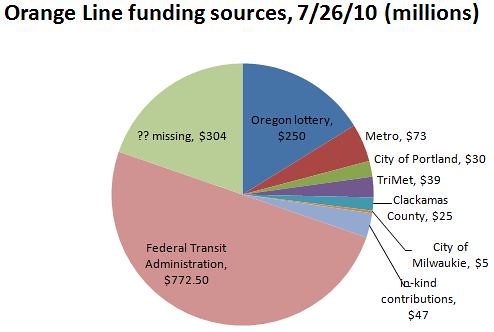
$300 million hole

This decision leaves TriMet about $300 million in the hole--around $470 million of local funding has been located, and 50% of $1.5 billion is $750 million.  According to GM Neil McFarlane, TriMet plans to tighten belts accordingly.   "Over the next few weeks, we'll be working with our project partners to recalibrate the project to fit within these new funding parameters" said McFarlane.  What "recalibate" means exactly is unclear, but according to spokesperson Mary Fetsch, who was interviewed by portlandafoot.com, part of the strategies being considered include eliminating parking garages, shrinking the maintenance facility and not ordering spare cars for trains on the line.

[Graphic courtesy of portlandafoot.com]

While those steps would save some money, it's hard to see the savings from those moves amounting to anywhere near $300 million.  And its hard to see where additional local funding might come from, given that government agencies of all sorts are dealing with budget problems--and if push comes to shove, MAX is not likely to be the highest funding priority.  If a funding package is not completed by the fall, the project may need postponement--which would put current funding in jeopardy.   Many other projects and constituencies in Oregon have uses lined up for $250 million in lottery dollars--and there's not guarantee that the figure would be made up in a future funding cycle.  (Especially if the GOP manages to retake control in Salem).  TriMet has discussed borrowing more itself--likely bonding more payroll tax revenue, in addition to the $39 million it already plans to contribute via this controversial form of financing--a maneuver which would no doubt make many of its rider base scream.

Not all of this mess is the agency's fault, of course--rail costs have gone through the roof in the past decade; and the current recession seems to have governments all around the country scrambling.  However, the agency has committed a few unforced errors of its own--and has opened itself to criticism that it is over-extending itself.

Unlike a few other projects on the drawing board, rapid transit in the Portland-OC corridor is important for the region's future.  My concerns about Milwaukie MAX chiefly lie around cost, not about the usefulness of the project.  But if the money isn't there, the money isn't there. 

Depending on what happens...maybe it's time to revisit BRT.

Milwaukie BRT

Consideration of BRT in the corridor is nothing new.  After the Milwaukie/Vancouver MAX funding initiative failed back in the 1990s, Metro gave serious consideration to various flavors of BRT in the early phases of the South Corridor study--a study which initially excluded light rail.  At the request of leaders in Clackamas County, LRT was added to the study, and eventually became the locally preferred alternative for both Phase I and Phase II of the project.  Phase I is now the MAX Green Line; Phase II is Milwaukie MAX.  The South Corridor Supplemental DEIS considered several options for the Portland/Milwaukie/Oregon City corridor, at the following price tags:

  • BRT from Portland to Oregon City (here, "BRT" means bus service enhanced with low-cost capital improvements such as signal priority, but not a full busway):  $119-$131 million.
  • Busway from Portland to Milwaukie, BRT from Milwaukie to Oregon City:  $267 million - $299 million.  ("Busway" means a fully dedicated ROW for the exclusive use of transit vehicles).
  • LRT from Portland to Milwaukie, BRT from Milwaukie to Oregon City:  $467-$518 million.
Careful readers will note that the current LRT price tag is 3 times the SDEIS estimate, and that doesn't include any bus enhancements south of Milwaukie.   Pretending the BRT part doesn't exist, that would be about $70 million per mile, about the same cost as the Yellow Line, which was under construction at the time.  The SDEIS glossed over the question of how MAX would cross the river (the maps included had trains going across the Hawthorne Bridge--a dubious notion), but the fact that the project has tripled in price since early planning illustrates the problem.

A few other proposals for a Portland-Milwaukie BRT have been floated, such as this one by John Charles of the Cascade Policy Institute (a libertarian think tank that has a reputation for not being terribly fond of public transit).  BRT was also discussed at portlandtransport.com when the decision to go with light rail was made.  Critics of BRT have noted that light rail "won" the technical analysis to become the LPA--the SDEIS predicted 33% more trips with the LRT solution than the busway, and 60% more than with BRT.   However, given the new project constraints, the prior analysis may no longer be sound.

[Image courtesy of South Corridor SDEIS]

A good potential BRT corridor

The Portland/Milwuakie corridor has good BRT potential for numerous reasons:
  • The Willamette River acts as a "funnel" for commuters; other than the Sellwood Bridge (presently closed to busses due to weight limits), there is no public crossing of the river between the Ross Island Bridge and Oregon City.  Numerous busses converge on the corridor from points east and turn north into the city.  
  • With the existing bus services along 99E, there is already frequent service along the corridor for the entire length (the #33), along with numerous other routes which provide augmented service during peak hours.  Even without introducing any additional routes, an "open busway" between Portland and Milwaukie would be an attractive transit corridor.
  • The SDEIS predicted 30,000 rides/day with the "busway" alternative, vs 40,000 for light rail (a figure which has been slashed as the issue has been studied further; a common phenomenon in planning).  Not bad for a second option.
The support of BRT I envision would be the "busway" alternative, with a fully dedicated bus lane.  In addition, even though it is one of the most expensive components of the Milwaukie MAX project as currently constituted, I would look to keep the Caruthers bridge, as the busway would have the greatest impact if there were a continuous exclusive-transit route between Milwaukie and the mall. (I would also love to see the Milwaukie-OC section added back into the project, even if only consisting of signal priority and queue jump lanes on McLoughlin).

Switching to BRT, or at least publicly considering it, could have significant political impacts as well.  It would demonstrate to TriMet's critics a greater regard for financial responsibility, and help to demolish the meme that "TriMet no longer cares about the bus system"--especially given Neil McFarlane's prior role with the agency.  Such political calculations ought not drive the decision, but it would be ignorant to ignore their potential impact.  And even if TriMet were to go ahead with light rail, it would improve the optics of the situation tremendously.

Opportunity

David Axelrod, President Obama's chief campaign strategist, is famous for saying "never let a good crisis go to waste".  With the financial straits facing the organization, and the greater ability to change direction afforded by a new general manager, TriMet has an opportunity here to greatly change the nature of transit politics in town.  It may be that reconsidering BRT remains a bad idea; and that the correct decision may be to proceed as planned, delay the project until costs come down or money becomes available, or no-build.  But one paradox of management is that constraints can be liberating, as they allow consideration of alternatives that were previously unthinkable.

Sunday, July 18, 2010

A few quick links

to two articles at The Urbanophile:
  • One, published this weekend, in support of busses--in part because rail costs have been skyrocketing (a phenomenon which is not unique to Portland or Oregon, but does appear unique to the United States). 
  • Another, from a year ago, discussing what is causing the skyrocketing rail costs, and what might be done them.
More grist for the mill.