Showing posts with label bus/rail. Show all posts

Tuesday, February 15, 2011

If users prefer rail to bus (or vice versa), what should be done about it?

Jarrett, writing once again on the theme of bus-rail differences (in preparation for a new book he's working on), writes an article on sorting out the rail-bus differences, along with a followup. In the series, he takes a list of (perceived) differences between bus and rail that were posted at The Infrastructurist, and sorts them into three categories: 
  • Intrinsic differences: Real technical differences between bus (including trolleybus) and rail (including, it appears, things like monorails and rubber-tire metros);
  • Misidentified differences:  Differences which are related to propulsion rather than guideway type, or differences which arise from how specific lines are implemented in specific systems
  • Cultural feedback effects:  Difference which arise from a result of cultural perception, law, or custom.
I won't repeat the list or the analyses here; go read the articles for those details.  However, there is a forest that is being missed for the trees.  Jarrett, I'm sure, knows this, but it merits pointing out.  The discussion of "cultural feedback effects" vs real vs miscategorized differences is important and useful, but there's a bottom line being danced around. That is:

1) There seems to be a quantifiable and measurable preference for rail over bus, at least in much of the developed world.

2) This preference may or may not be rational, may or may not be alterable (to the extent that planners ought to try), and may be conflated with issues dependent on local circumstances or practice, or who knows what else. (True apples-to-apples comparisons are often hard to make).

Given all of that, what should we (transit advocates, planners, decision-makers, or anyone else who cares about this) do about it, whether in planning individual lines or entire systems?  Specifically:

  • When and where should planners and decision-makers include modal biases in their forecasts (i.e. "a light rail line will attract X passengers per day, a BRT line will attract Y") and how much weight should these things be given?
  • To what extent should transit agencies, et al, attempt to change these views?
There are plenty of schools of thought on the issue.  One one hand, there's a school of thought that says that if reputable data (and proper decision-making requires access to good data) demonstrates a modal bias, that should be reflected in any subsequent analysis, and not colored by political considerations.

There's another school of thought that holds that such biases ought not be considered, especially if they are likely to be irrational (i.e a survey states that 20% more riders will ride on rail than on an equivalent bus line, and the stated reason for that preference is that busses are slow and full of drunks), and that only good "hard" reasons for one choice or another should be considered, such as cost or technical parameters, and that "illegitimate" reasons for a preference ought to be given no weight.  (This view is especially common when the reasons involved can be demonstrably reduced to racism or other forms of prejudice, which good public policy ought to oppose).

Some go so far as to suggest that modal bias (unjustified by tangible differences) is a problem that transit agencies ought to try and solve.


But these questions are ultimately political ones--decision-makers need to take all relevant factors into account.  I tend to favor providing as much quality data as possible to decision-makers, and letting them handle the politics.  (Not that they will necessarily do a good job here, but that is their job...) And while many non-intrinsic differences may be irrelevant in the abstract, they are often quite relevant in the context of a particular agency or system--if rail solutions gets signal priority at grade crossings as a matter of law whereas bus does not, or if a particular agency is not willing to add a new type of rolling stock to a fleet as part of a system expansion, these are important factors to consider.  If there are changes for the better in the wider environment (cultural, regulatory) that can be made, then plan for those; but transit systems have to exist in a particular place.

And difference which are specific to that place can frequently be just as important as those differences which are universal.

Friday, August 20, 2010

Induced demand and transit

Jarrett, as he usually does, has another interesting post up on Human Transit on the subject of whether or not rail attracts more riders than bus.  He points to some research done by a Munich transit planner (who subsequently joins the conversation in the comments) suggesting that this is the case, comparing various mid-sized (under 500,000) European cities with trams and without, noting that the cities considered in the study who have trams generally have higher ridership than those without.

Jarrett asked the fundamental chicken-and-egg question:  Was the construction of streetcars (in most cases, lines running in an exclusive right-of-way, functionally more similar to the MAX Yellow Line than Portland Streetcar) a driver of demand, or a response to it?  In other words, "did the trams cause the ridership, or did the ridership cause the tram?"

The chicken...

This is a good question.  A big technical advantage of rail over bus is vastly greater passenger capacity--and many successful rail lines have been built in bus corridors that got too crowded.  A common argument against rail projects (or against capital-intensive busways) in corridors that aren't already crushloaded to the gills at three minute headways, is "the existing demand doesn't justify the investment".   One commentor, "Danny", asserted that:

All successful high speed rail systems were capacity expansions for crowded low speed rail systems. All failing systems were constructed under the impression that speed causes ridership. 

While I respectfully disagree with his use of the universal quantifier "all"; and I  disagree with the first half of his statement completely (I can think of many counter-examples), the second half of the sentence has a lot of truth:  Many "failing" systems (by which I assume he means systems with usage levels far less than predicted) were constructed based on ridership increases which didn't come too pass.  If you build a rapid transit line in place of a local bus line and cancel (or reduce in frequency) the latter, you already have established a reasonable floor for the utilization of the rapid transit line--the bulk of the bus passengers will switch.  OTOH, if you are anticipating additional ridership that isn't there... there's a far greater chance you will be wrong.

...or the egg?

But, there's also a good chance you'll be right.  The Munich transit planner who produced the above-referenced paper surfaced in the comments, and had this to say. 

When you have cities of a similar size and density usually you should expect a similar ridership of public transit. But obviously, in average, it is not like that. So I sent Jarrett the data as one indicator for this "tram bonus", as we call it, that is able to get people out of their cars, like a bus system would never be able to do it.
Even the successful BRT systems in different cities do usually just channel a demand that already exist, a high demand of captive riders. Who ever has a car in those cities still uses it. 
We believe in the ability of a tram system to attract more people, people who would never set a foot into a bus, and we invest a lot of money in that. And: no matter if we are right or wrong with this "belief", it does work indeed. We see the numbers, we see the ticket sales and it makes sense, even from the economic perspective. It does not make sense for any bus line, but you can expect to increase ridership in a dimension of 50% to 100% on a line, compared to the bus service. If that makes sense for you, then do it.
Doug Allen, a local transit advocate (who was involved in the planning for the initial MAX line, and still works for TriMet--his words, obviously, aren't necessarily the opinions of his employer) added his two cents:
I would agree with "TransitPlannerMunich" that experience with the conversion of a bus route to tram, in a city with a mature system of bus and rail, can provide insight into whether passengers prefer rail over bus.

The implementation of the "Yellow" light rail line in Portland Oregon also showed that a rail line that is shorter and less frequent than the bus service that it replaced can attract higher ridership, no matter how irrational this may seem.
Doug refers to the now-gone 5/Interstate, which ran from Hayden Island along Interstate Avenue to downtown Portland.  The Yellow Line doesn't presently serve the island, and runs at 15 minute headways, so in at least two respects, it's inferior to the bus service it replaced.

Neither Doug or "TransitPlannerMunich" offered any explanation why they observe a presence for rail; formal research on the "tram bonus" is inconclusive.  And other commenters wondered whether or not reconfigurations of bus service (converting parallel downtown routes into feeder routes) might boost rail ridership without boosting overall commute share.  Many properties which riders attribute to bus and rail, are often properties of the local implementation thereof--if, for example a transit agency operates 40' diesel busses through rough neighborhoods with no capital improvements on the bus routes, alongside modern light rail that sticks to the nicer parts of town--don't be surprised if local residents characterize the bus as dirty, noisy, slow, unreliable, and full of unsavory characters.  Bus can be clean and fast, and rail can be slow and uncomfortable; there is much overlap in the service parameters for both.   On the other hand, if there is a demonstrated community preference for one mode over the other--even if entirely irrational--that's something that ought to be factored into planning.

Induced demand

Which leads us to the subject of induced demand-- the "Field of Dreams" problem. ("If you build it, they will come").  If the supply of a given resource is increased, then more of it is often consumed.  This is especially true when the existing supply is insufficient (or barely sufficient) to meet the existing demand; there's often lots of pent-up demand that is more than happy to consume the new supply.  A related phenomenon is value-induced demand; if you increase the value (quality) of a resource, without increasing the cost, demand will also rise.  Both phenomena are in the realm of Economics 101.

Induced demand is frequently invoked in arguments concerning construction or expansion of freeways, where congestion relief is cited as a justification for the bulldozer and the mixer.  Highway opponents frequently point out that when freeway capacity is added, it frequently fills up with additional traffic, causing a failure to deliver on the expected congestion relief.  (Freeways suffer from a fundamental scalibility problem as well--additional traffic, even if below capacity, increases the chance of a wreck, stall, or other incident which severely impacts service.) 

But induced demand works for transit as well.  Transit opponents frequently point out the same thing about transit projects sold on the basis of congestion relief--even if the transit service attracts motorists out of their cars, other motorists often take their place.  But the principle applies:  When transit service improves, either in capacity or in quality, more people will elect to use it.  The improvement can be manifested in values which are easily measured--coverage, capacity, frequency, speed, reliability--or in those values which are less tangible and may reflect social facts or personal biases (comfort, prestige, sex appeal, environmental benefits, etc).  Either way, if you make a service more attractive to the population, more people will use it.  And the advantage that transit has over the automobile (considering only the geometric aspects of it, and ignoring the numerous negative externalities of cars which provide ample additional reasons for transit construction) is one of scalability at high density.
 
The reverse phenomenon is also readily observed:  when you cut service, ridership levels go down--decreases in line frequency or other service parameters will often drive riders to other modes, or to not make trips at all.

How badly do you want it?

These phenomena can be explained by the property of elasticity--a concept which is the way economists answer the question, "how badly do you want it?".  (Actually, it measures the inverse of that question--a lower elasticity means that the product or service is "wanted more badly").  Many transit advocates who know little about economics understand the fundamental concept of elasticity--the concepts of "choice riders" and "transit-dependent" refer to two different populations who express different elasticities with regard to their transit-using habits.  Choice riders express a high elasticity--meaning that their consumption (use) of transit is likely to change as the value proposition changes; if the fares go up or the frequency goes down, they stop riding, and if service improves, they may switch back to transit.  Transit-dependent riders express a low elasticity--they'll put up with a lot because they have no other choice, and conversely, improving service isn't likely to attract more transit-dependent riders, as those who need the service are already using it.  A third community to consider is the transit-averse:  those who won't use transit under any circumstances.  They also express a low elasticity, as improvements to the system are unlikely to entice them to increase their consumption (usage), which will remain at zero.

One interesting phenomenon concerning elasticity is that it goes up in a recession.  Even if the capacity remains adequate and the coverage remains the same, when a recession occurs, cuts to service are more likely to negatively affect ridership during hard times.  When a recession occurs and people lose their jobs, two things happen:  unemployed riders for whom transit demand was previously inelastic suddenly find it elastic, as they no longer need to be at work by a certain time.  And congestion on roadways decreases, increasing the relative value of driving for those who can drive (which is the majority of the population in most parts of the US)  .   This is why "death spirals" are a pressing problem for transit agencies during a recession--loss of revenue leads to service cuts which leads to loss of riders which leads to loss of revenue which leads to... you get the picture.  (When a transit agency finds itself in this situation, as TriMet appears to be, you had better hope that the pattern of panic/cut/cringe converges at a level well about zero).


Its all about the values

When publicly-operated rapid transit projects are proposed, there are often several reasons offered to justify the expenditure of public funds:
  • Increasing coverage
  • Increasing capacity
  • Increasing service quality
  • Decreasing operating costs
  • Environmental outcomes
  • Land-use outcomes
  • Economic development
The first three are important to transit users (and potential users).  The others are important to other constituencies (the transit agency, the public at large, etc) and won't be considered further.  Whether any of these are important to a given rider or group depends on what the rider or group's goals are.  And if a person takes a more minimalist view of transit--s/he may not be interested in attracting riders to the system--and consider expenditures for that purpose a waste of money. While I can't point to research to back it up, it seems apparent that many of those who adapt the minimalist point of view are those for whom transit demand is most inelastic.  the transit dependent, who have every reason to be skeptical of proposed new projects--many of which will benefit some other community and adversely affect the particular service they depend on; and the transit-averse, who won't ride the system at all, and may view the entire enterprise as a big waste of money.

This dichotomy may affect one's answer to the question posed by Jarrett at the top of this article.   It's a common psychological phenomenon to project ones thoughts and beliefs onto others.  Thus, if an individual's personal demand for transit is inelastic (or one's own personal value system WRT transit focuses on tangible service parameters such as coverage, capacity, and performance, and disregards things like amenities or social acceptance), s/he may assume that this is true for others--and question the claim that improving transit quality may increase ridership.  Likewise, if a person's personal transit demand is highly elastic (or is motivated by factors specific to a particular mode choice), s/he may assume that increasing service levels (including by conversion to rail) will axiomatically drive up demand--and further assume that what is important to him/her, is important to everybody, thereby causing an overestimation of the induced demand.

The truth, of course, lies somewhere in between, and ought to be determined empirically rather than by ideological catfights between different communities and constituencies.

Friday, August 13, 2010

Transit minimalism, and why the left and the right frequently come together to oppose rail

The Milwaukie MAX project, and its escalating costs and increasingly unstable funding, has become a prime target of criticism.  While I'm critical of quite a few particulars of the project (its cost, for one; it's routing, for another)--most of my criticisms center around particulars of the project itself and the current economic climate.  I think the corridor in question needs to have rapid transit of some form--by which I mean "real" rapid transit that runs mostly (if not completely) in an exclusive right-of-way.  Rail or bus is a secondary concern.

However, much of the criticism of the project goes well-beyond the details of Milwaukie MAX, and instead takes the form of an outright anti-rail position.  Several different identifiable factions have been advancing anti-rail positions, asserting that TriMet ought to cancel the project outright, and not advance any other rail projects for the foreseeable future.  (Occasionally one even sees the suggestion that the existing MAX lines ought to be dismantled and replaced with something else; a position I won't consider further).  Many of these factions have entirely different motivations and goals--in some cases, they even conflict--but their positions all lead them to the same conclusion.

The positions in question, and several others, were previously discussed in this post on transit agency missions; here we focus on only three.  Some of the criticisms discussed herein extend to other forms of rapid transit as well, such as BRT; others are rail-specific.

Social justice

One common set of light-rail critics are to be found in the community of activists desiring social and economic justice.   A prominent such organization in Portland is OPAL (Organizing People/Activating Leaders), which has, on numerous occasions, called for TriMet to halt future light rail constructions and instead provide more bus service.  OPAL's John Ostar, speaking to TriMet on the proposed property tax levy now on the November ballot, had this to say:


What we're doing – what you're doing, essentially, is requiring voters to pass bonds for absolutely essentially service, essential infrastructure, basic infrastructure. Things that we have payroll tax revenue to pay for. But instead, we're now using that payroll tax revenue to pay for non-essential service – light rail - and requiring voters to pass bond measures to pay for essential service. I think that we have it backwards.

Emphasis added by me.  Clearly, Ostar considers light rail to be a "non-essential" service--an interesting position to take given that 1/3 of unlinked trips are on MAX and not bus.  But when you consider what OPAL considers important, and what they do not, it makes perfect sense:
  • OPAL, and similar advocates, think that a key part of TriMet's mission ought to be providing transit to the "transit-dependent"--people who cannot afford an automobile, or who otherwise cannot drive.  Given that the transit-dependent (and their destinations) are often widely-dispersed in the region, that leads to service patterns which require coverage of a large area rather than focusing on a smaller corridor--a pattern of service that is easier to provide with busses (and in many cases, with paratransit).
  • Poverty advocates are generally less concerned with attracting "choice riders", providing extensive service to wealthier parts of town, increasing transit's mode share, or using transit as a land-use tool.  Amenities beyond basic coverage and service frequency/speed/reliability are deemed unimportant.  They are especially  wary of anything that looks or smells like gentrification--almost always a bad thing if you're poor.  (Your neighborhood might improve, but you won't be able to afford it anymore).  Many of the stated goals of rapid transit--especially rail--are simply unimportant to advocates to the poor, and some are viewed with hostility.
  • Many poverty advocates are generally distrustful of government--which is often seen as in the hands of the wealthy and powerful, and inherently indifferent (or hostile) to the interests of the disadvantaged.   Such advocates, when a large project is proposed by the government, frequently start to smell a rat.
In a world with unlimited funding (or at least in one in which comprehensive, quality bus service is provided), I suspect that capital-intensive projects would not raise much objections among the social justice community--especially if the projects were demonstrated to improve service in ways that were considered important--but in a limited funding environment, any concentration of resources on a particular corridor is problematic--especially if the result of such concentration is higher rents along the line.

Economic conservatives

A second group who can be counted on to oppose capital transit projects are what I'll call "economic conservatives"--a group which includes libertarians, many Republicans, and a broader spectrum of the population that objects to high(er) taxes for services they consider to be wasteful or non-essential.  Motivations can range from ideological ("transit shouldn't be provided by the government"), to financial ("I don't want to pay for transit I don't intend to use"), to skepticism concerning particular agencies ("Sam Adams/TriMet/Metro are all crooks"), to hostility toward the community of transit users ("Those damn hippies ought to get a job and buy a car like the rest of us").  This community also includes a fair amount of lobbyists for industries (auto, petrochemical) which frequently regard transit as competition.  With the financial crisis and economic downturn, calls for greater fiscal austerity ("light rail is a luxury we can't afford") get added to the mix. 
The overriding concern for this group is that dedicated-ROW rapid transit, particularly rail, is too expensive.  While some in this group would eliminate public transit altogether, there is a significant faction that supports what I call "subsistence transit"--transit that provides basic mobility to those who have no other choice, but of a quality which is so low that only the desperate (or dedicated) would use it.  Almost invariably, this means POBS ("plain old bus service"), usually running at low frequencies--virtually any capital improvement to the system or attempt to provide frequent service (other than in places and times where the busses are crowded otherwise) is, by definition, superfluous.  This may superficially appear to be similar to the social justice position--which also isn't interested in expansive service--but differs in several important ways.  Where as the social justice advocate generally wants to provide decent transit to the communities s/he represents, those supporting subsistence transit generally care first and foremost about cost.
While some conservatives do generally care about (and will defend) basic levels of transit service; there are others who want to do away with it altogether--and frequently use the characteristics of "social service" transit to attack transit.  Social service transit is inefficient by its nature (the busses are often empty); and that is used to advance arguments that the transit agency is incompetent (otherwise the busses would be full!), or that transit is not environmentally friendly (an empty bus is less fuel-efficient than a single-occupant automobile, after all), or that it's wasteful because hardly anyone uses it (which is, after all, the point).
Conservatives are also frequently skeptical about politics and government in general--especially in large cities, where the political scene is often dominated by liberals.  Charges that rapid transit projects are exercises in "social engineering", or represent forthcoming Soviet-style totalitarianism, or are intended to enrich labor unions, are common.

Speaking of unions...

A third constituency which is often hostile to rapid transit, especially rail, is transit unions--and the reason is obvious:  Jobs.  The biggest operating cost for transit agencies is labor; and one of the selling points of rapid transit--especially rail--is that you can provide the same capacity and service levels with fewer payroll hours.  While this can mean increases in service without corresponding increases in labor cost, in practice it often means reductions in hours, or layoffs.  And while some transit agencies (such as Muni in San Francisco) are notoriously labor-friendly, in most cases, the agency and its workforce have a relationship that is at least somewhat antagonistic.

What do these all have in common?

What do these positions have in common?  Several things:
  • A belief that the specific benefits provided by rapid transit are unimportant, and thus not worth spending money on.
  • A desire for transit minimalism--lack of interest in increasing ridership or service beyond some baseline level which is held to be "good enough"; in particular, a lack of interest in attracting "choice riders" to the system.
  • A lack of confidence in transit management/governance, often causing disbelief in the stated goals of the project(s) in question, and/or the projections concerning population growth, future ridership demands, and future revenue used to justify such projects.  In many cases, this is expressed as a public officials are acting in bad faith.
Of course, the different groups have lots of things which are not in common--fundamentally, social justice advocates are interested in service quality; conservatives in minimizing public costs; and labor advocates in maintaining payrolls and jobs.  These things are all somewhat in conflict--if you reduce the budget, you either have to slash service (and hours) or wages.  Increase wages, and either revenue must increase or service must be cut.  And increasing service requires either new revenue, or wage concessions. But in all cases, there is a fear that if money is diverted from the taxpayers, or existing uses, to fund new capital construction--that there won't be any return on that investment or expenditure.   And driving that fear, in many cases, is a lack of trust in the transit agency.

When someone makes a statement that light rail is not an "essential service", or that it is "anti-transit"--it is good to ask of them what their vision for the transit system is.  Chances are, their vision is one of minimalism--they believe that transit has a limited (and specific) role to play in the overall economy and infrastructure of a place, and that attempts at expansion are out of line.

A few final thoughts

Many transit activists, including yours truly, don't subscribe to the minimalist philosophy.  After all, we (as a society) haven't practiced minimalism when it comes to road-building over the past century--there's scarcely a capacity problem on the roads that doesn't provoke calls to build more of them.  And the result is a mess--and will become a larger mess the next time gas heads north of $4 a gallon.  I'm not a maximalist, either--I'm fully cognizant of the political and financial constraints which are in place, and believe that projects need to undergo public scrutiny.

However, the absolutist positions expressed by some, are extensively troubling.  They're political arguments couched as technical arguments.  (This is true for light-rail supporters as well).  It's far more open and honest to say things such as "I think TriMet should focus on social service to the poor, and not on trying to attract motorists from their cars", rather than attacking a particular mode choice as unsound.  It's better to have an open debate about values--what sort of service should be provided, then cloud that debate in pissing matches about bus vs rail.  Because that's what the debate is really about.  Arguments about mode choice are really arguments about values, and the vast majority of participants in transit blogs (including myself) have only a superficial understanding about the limitations of various technologies--often colored by what TriMet (or whoever the local transit agency is) does in practice. 

Sunday, August 1, 2010

Tax increment financning and transit

Last week, the web site portlandtransport.com posted a five-part series of an interview with new TriMet director Neal McFarlane.  The interview touched on numerous topics, but a significant portion of the video dealt with the current financing crisis at the agency (and at many other transit agencies, and state and local governments in general).  One of the more contentious topics was the use of tax increment financing to pay for improvements to transit infrastructure and service. 

The video included several people giving testimony at a TriMet board meeting, in opposition to the practice--including the sheriff of Clackamas County and the chief of Clackamas Fire District, whose territories are served by the MAX Green Line, and the planned Milwaukie extension.  Both of them complained that TIF, which has been used in the past to finance improvements to the transit system, was hampering the finances of their respective departments, by simultaneously creating new demands for service and depriving them of revenue with which to provide that service.  Also appearing in the video was conservative political activist Steve Schopp, who has engaged the producers of the video (and yours truly) in the comment threads at portlandtransport.

And while I disagree with much of what Steve has to say, on this issue he's got a valid point.

What is TIF?

Tax-increment financing (TIF) refers to a means of public financing whereby the portion of property taxes (or other taxes) collected on certain parcels of land, which goes to the general fund, is frozen--with the difference being used to finance capital projects designed to improve the value of said parcels (and bring about some public benefit as well).  Generally bonds are issued to finance the actual project, and the tax-increment is used to pay back the bonds until they are retired.  This is especially important for Oregon, where Ballot Measures 47/50 limit property tax increases to 3% per year; unless the property in question is , or the taxes are to service bonded indebtedness.  TIF seems simple enough, but it has a few issues, even when used "properly":

  • Inflation may not be accounted for--if baseline costs to provide government services are rising due to inflation, but the revenue provided is frozen, cuts to service may result.
  • Sometimes the new development may increase the need for government services, such as turning a brownfield into a dense mixed-use residential zone.  Brownfields seldom need service from the police or paramedics, whereas places where people live often do.
The graph to the side, apparently designed by local TriMet critic (and frequent portlandtransport.com commenter) Jim Karlock for an anti-urban-renewal article at bojack.org, demonstrates how it works.  Whether or not the section labelled "red ink" is truly red depends on how expenses grow or shrink; in a well-designed TIF the red ink is minimal or nonexistent.

When does TIF work?

TIF works best when the following conditions are met:
  • The improvements are largely specific to those parcels being tabbed for tax-increment financing. 
  • The improvements may decrease, or at least minimize the increase, the need for public expenditures
  • The resulting property value increases are of sufficient magnitude that the bonds can be paid of quickly, returning the full value of the tax base to the general fund.
A common use of TIF that meets these requirements is certain types of urban renewal; where blighted neighborhoods are rebuilt.  Urban renewal of this sort satisfies the conditions--specific lots are affected, the improvements are frequently substantial, and the elimination of blight and the related social pathologies may well reduce public expenses.  (This analysis ignores the effects of gentrification--in particular, the beneficiaries of such projects are often landlords and developers, not people who live there who may be forced out due to higher rents or taxes.  But that's another subject).

What about infrastructure?

What about public infrastructure, such as roads, bridges, or transit lines?  At a neighborhood level, TIF (or better yet, Local Improvement Districts, where specific local taxes are levied against a neighborhood to pay for improvements), it can work.  But for major regional infrastructure projects, such as freeways or MAX lines, not so much:

  • Many demands for service are not reduced, and may increase, if the improvements result in more people living in the area (or travelling through).
  • Such things are built on public rights-of-way (whether on easements or owned by the public outright), not on private lots subject to taxation--in other words, the directly affected land is off the tax rolls.  Instead, TIF depends on general increases in the value of nearby properties to work.
  • For large-ticket projects, the size of the TIF district needs to be also large; magnifying the risk to other government functions should the projected increases in value not materialize, or should inflation or other causes increase government expenses unrelated to the project, which must be met with a frozen tax base.
What's the best way to finance major infrastructure projects?  For large capital projects which are regional in scope--the traditional way (an explicit bond measure backed by a specific tax levy) is probably the cleanest way to do it--it doesn't affect existing services, it demonstrates political will to do the project, and it represents a stable source of revenue which makes lenders happy, lowering the cost of financing.

Voterphobia

Unfortunately, TriMet lost a measure in 1996.  Actually it was a statewide measure, Measure 32, that authorized using lottery funds to fund the N/S MAX project and numerous road projects elsewhere--one that was put before voters during the height of the Oregon tax revolt.  But it failed--and since then, TriMet seems terrified to go before the voters to raise money for capital projects (or to use existing bonding authority that it has used but has not exercised).  Instead, we get things like TIFs, bonding payroll tax revenues (the source of much of TriMet's operating budget), and the like to fund capital projects.

Some parting advice

A bit of advice to TriMet.  Your service area includes Portland.  A place which is highly transit-friendly.  The greater Portland metro area, excluding Vancouver, presently sends THREE Democrats to Congress.  I don't expect either Wu or Blumenauer to lose this November; Kurt Schrader is a bit more vulnerable, but the GOP has nominated yet another nutcase.  While the following advice might not fly during the current recession, what with everyone grabbing their wallets, I will nonetheless offer it:

Trust the voters.  The bulk of the populace supports transit, especially if you can convince them that you know what you are doing, and aren't just wasting taxpayer money on patronage projects.  Demonstrate some fiscal soundness, quit f---ing around with crazy financing schemes, grow a pair, and put a bond levy for Milwaukie MAX on the ballot.  Or better yet, put a levy for MLR, Barbur, and improvements for the WES corridor on the ballot, so all three counties get some cake.  Even better than that, put different proposals on the ballot (light rail, BRT) and let the people decide what quality of transit they are willing to pay for.  Or not.

But enough with the current "system" of scraping together funds from a zillion different sources to pay for major infrastructure projects.  It makes it look like TriMet and Metro are trying to hide something; it puts you in hock to a whole lot of folks who don't give a damn about quality transit, and when it results in service cuts, it alienates the demographic you can least afford to alienate--your current supporters. 

As stated previously, the appointment of a new GM is an opportunity, a chance to wipe the slate clean, and break from the past policies of the agency which have been met with much scorn. 

And after all--if you don't trust the voters, why the hell should they--should we-- trust you?

Tuesday, July 27, 2010

Milwaukie BRT?

Today, it goes without saying, was not a good day for the Milwaukie MAX project.  Only a few days after the projected budget for the project went up by $100 million, the FTA made official what may have been unofficially known to TriMet for about a year; they are only planning to match local funds evenly ("50% match"), rather than contributing $1.50 for every local dollar ("60% match").  The stated reason?  The FTA doesn't want to "set a precedent" for matching big-ticket projects at such high levels.  There's probably lots of other politicking going on in DC, as the transportation bill is stalled in the Senate (like everything!), but given FTA chairman Peter Rogoff's recent remarks about allegedly-overpriced rail projects, I'm not surprised.

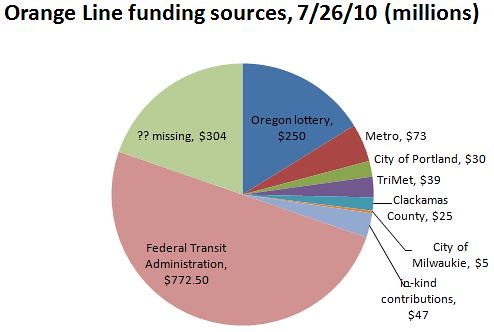
$300 million hole

This decision leaves TriMet about $300 million in the hole--around $470 million of local funding has been located, and 50% of $1.5 billion is $750 million.  According to GM Neil McFarlane, TriMet plans to tighten belts accordingly.   "Over the next few weeks, we'll be working with our project partners to recalibrate the project to fit within these new funding parameters" said McFarlane.  What "recalibate" means exactly is unclear, but according to spokesperson Mary Fetsch, who was interviewed by portlandafoot.com, part of the strategies being considered include eliminating parking garages, shrinking the maintenance facility and not ordering spare cars for trains on the line.

[Graphic courtesy of portlandafoot.com]

While those steps would save some money, it's hard to see the savings from those moves amounting to anywhere near $300 million.  And its hard to see where additional local funding might come from, given that government agencies of all sorts are dealing with budget problems--and if push comes to shove, MAX is not likely to be the highest funding priority.  If a funding package is not completed by the fall, the project may need postponement--which would put current funding in jeopardy.   Many other projects and constituencies in Oregon have uses lined up for $250 million in lottery dollars--and there's not guarantee that the figure would be made up in a future funding cycle.  (Especially if the GOP manages to retake control in Salem).  TriMet has discussed borrowing more itself--likely bonding more payroll tax revenue, in addition to the $39 million it already plans to contribute via this controversial form of financing--a maneuver which would no doubt make many of its rider base scream.

Not all of this mess is the agency's fault, of course--rail costs have gone through the roof in the past decade; and the current recession seems to have governments all around the country scrambling.  However, the agency has committed a few unforced errors of its own--and has opened itself to criticism that it is over-extending itself.

Unlike a few other projects on the drawing board, rapid transit in the Portland-OC corridor is important for the region's future.  My concerns about Milwaukie MAX chiefly lie around cost, not about the usefulness of the project.  But if the money isn't there, the money isn't there. 

Depending on what happens...maybe it's time to revisit BRT.

Milwaukie BRT

Consideration of BRT in the corridor is nothing new.  After the Milwaukie/Vancouver MAX funding initiative failed back in the 1990s, Metro gave serious consideration to various flavors of BRT in the early phases of the South Corridor study--a study which initially excluded light rail.  At the request of leaders in Clackamas County, LRT was added to the study, and eventually became the locally preferred alternative for both Phase I and Phase II of the project.  Phase I is now the MAX Green Line; Phase II is Milwaukie MAX.  The South Corridor Supplemental DEIS considered several options for the Portland/Milwaukie/Oregon City corridor, at the following price tags:

  • BRT from Portland to Oregon City (here, "BRT" means bus service enhanced with low-cost capital improvements such as signal priority, but not a full busway):  $119-$131 million.
  • Busway from Portland to Milwaukie, BRT from Milwaukie to Oregon City:  $267 million - $299 million.  ("Busway" means a fully dedicated ROW for the exclusive use of transit vehicles).
  • LRT from Portland to Milwaukie, BRT from Milwaukie to Oregon City:  $467-$518 million.
Careful readers will note that the current LRT price tag is 3 times the SDEIS estimate, and that doesn't include any bus enhancements south of Milwaukie.   Pretending the BRT part doesn't exist, that would be about $70 million per mile, about the same cost as the Yellow Line, which was under construction at the time.  The SDEIS glossed over the question of how MAX would cross the river (the maps included had trains going across the Hawthorne Bridge--a dubious notion), but the fact that the project has tripled in price since early planning illustrates the problem.

A few other proposals for a Portland-Milwaukie BRT have been floated, such as this one by John Charles of the Cascade Policy Institute (a libertarian think tank that has a reputation for not being terribly fond of public transit).  BRT was also discussed at portlandtransport.com when the decision to go with light rail was made.  Critics of BRT have noted that light rail "won" the technical analysis to become the LPA--the SDEIS predicted 33% more trips with the LRT solution than the busway, and 60% more than with BRT.   However, given the new project constraints, the prior analysis may no longer be sound.

[Image courtesy of South Corridor SDEIS]

A good potential BRT corridor

The Portland/Milwuakie corridor has good BRT potential for numerous reasons:
  • The Willamette River acts as a "funnel" for commuters; other than the Sellwood Bridge (presently closed to busses due to weight limits), there is no public crossing of the river between the Ross Island Bridge and Oregon City.  Numerous busses converge on the corridor from points east and turn north into the city.  
  • With the existing bus services along 99E, there is already frequent service along the corridor for the entire length (the #33), along with numerous other routes which provide augmented service during peak hours.  Even without introducing any additional routes, an "open busway" between Portland and Milwaukie would be an attractive transit corridor.
  • The SDEIS predicted 30,000 rides/day with the "busway" alternative, vs 40,000 for light rail (a figure which has been slashed as the issue has been studied further; a common phenomenon in planning).  Not bad for a second option.
The support of BRT I envision would be the "busway" alternative, with a fully dedicated bus lane.  In addition, even though it is one of the most expensive components of the Milwaukie MAX project as currently constituted, I would look to keep the Caruthers bridge, as the busway would have the greatest impact if there were a continuous exclusive-transit route between Milwaukie and the mall. (I would also love to see the Milwaukie-OC section added back into the project, even if only consisting of signal priority and queue jump lanes on McLoughlin).

Switching to BRT, or at least publicly considering it, could have significant political impacts as well.  It would demonstrate to TriMet's critics a greater regard for financial responsibility, and help to demolish the meme that "TriMet no longer cares about the bus system"--especially given Neil McFarlane's prior role with the agency.  Such political calculations ought not drive the decision, but it would be ignorant to ignore their potential impact.  And even if TriMet were to go ahead with light rail, it would improve the optics of the situation tremendously.

Opportunity

David Axelrod, President Obama's chief campaign strategist, is famous for saying "never let a good crisis go to waste".  With the financial straits facing the organization, and the greater ability to change direction afforded by a new general manager, TriMet has an opportunity here to greatly change the nature of transit politics in town.  It may be that reconsidering BRT remains a bad idea; and that the correct decision may be to proceed as planned, delay the project until costs come down or money becomes available, or no-build.  But one paradox of management is that constraints can be liberating, as they allow consideration of alternatives that were previously unthinkable.

Sunday, July 18, 2010

A few quick links

to two articles at The Urbanophile:
  • One, published this weekend, in support of busses--in part because rail costs have been skyrocketing (a phenomenon which is not unique to Portland or Oregon, but does appear unique to the United States). 
  • Another, from a year ago, discussing what is causing the skyrocketing rail costs, and what might be done them.
More grist for the mill.

Time for Plan C?

The Lake Oswego transit project has been a hot topic there this weekend.  The latest cost estimate for the project is nearly double previous estimates.  Some of that cost is the result of changing estimates for the value of the Jefferson Branch real estate, a cost which is already paid for (it's both a debit and a credit on the books), and will be matched at 1.5x--the "out of pocket" costs for the region are more in the range of $50-$75 million.  However, the size and scope of the cost increase is a bit disturbing, and isn't entirely accounted for by the ROW value.  (Not even close).  The politics are lousy, to be frank.

The problems

There are two bigger problems, however.  The projected "out-of-pocket" costs (excluding the ROW) to the region are expected to be a small fraction of the overall cost of the thing--$50-$75 million or so.  That actually looks good--if the region can get a 6x-9x multiplier on its cash investment, it might be a good deal.  The flies in the ointment are these:
  •  Until an appraisal is done, the actual value of the ROW will not be known.  Appraisal probably won't be done for a while; and may be an avenue for opponents of the project to tie it up in court.  (Those trying to sabotage the project may argue for a lesser value; those trying to cash in if their adjacent property is condemned may try to escalate the value).  A proper project budget depends on this, obviously.
  • The technical parameters of the project are... underwhelming.  The proposed route is no faster than the existing parallel bus line (it is expected to offer improvement when projected traffic increases tie the bus up in traffic); the capacity of the project is very low by mass transit standards (less than 1000 pphpd, assuming single-car Streetcars at no better than 10 minute headways); and the land-use potential seems limited.  Other than the SOWA area, and perhaps the Foothills area in Lake Oswego; most of the land along the line is either already developed, or geographically unsuitable for development.  (And those portions outside the Portland city limits are outside the scope of Portland Streetcar's organizational mission).  Given that--why would the FTA consider spending $240 million on this project, over other worthwhile projects in the country (and even possibly in the Portland area)?  Peter DeFazio might be in a position to steer an earmark Portland's way if the Democrats retain control of the House; beyond that, prospects strike me as dubious.  Given that the region will need to spend another $25 million or so to get to the point of submitting an application for the funds--money that will NOT be matched or reimbursed should the feds say no--is there a better way?
Plan B

The Streetcar alignment (including the trail option) is Plan A, of course.  There is a Plan B--the "enhanced bus" option.  In this option, no Streetcar is built; the ROW is used for a trail, and limited-stop bus service, augmenting or replacing the 35, runs along the OR43 corridor, with limited stops north of Lake Oswego.  Unfortunately, the "enhanced bus" option runs along 10th/11th through downtown, rather than the transit mall, a flaw which the proposed Streetcar alignment shares.  I suspect this routing was done to make the "enhanced bus" option a substitute for the Streetcar option--but if you're a cynic who thinks the bus option is only there because the law says it has to be, and isn't being seriously considered--this routing sure looks like a poison pill.

There is also "Plan Zero"--no-build.  Here, no capital improvements are made to either rails, trail, or bus infrastructure, and the 35 runs as before.  It is on TriMet's list of Lines To Promote To Frequent Service, but the agency is having trouble maintaining current levels of service.

Plan C?

Let's assume, for a moment, that we decide Lake Oswego Streetcar isn't a great idea--but that transit in the OR43 corridor is going to be a pressing concern in the next few decades.  Assume that population and traffic projections a few years hence are accurate, and OR43 will no longer be a convenient route for busses to use, due to congestion.  For riders from Oregon City, switching to the 33/MAX will be an option, but for riders from West Linn, that won't be.

Ignore the trail, for a bit.

And assume that the funds that the region were planning to use on the Streetcar could be invested on some other piece of infrastructure in the region.  What would be a good option?

Transit bridge across the Willamette, perhaps?  

In Metro's high capacity transit plan, one of the longer-range transit corridors connects Clackamas Town Center with Washington Square.  While the endpoints are strange--there is a substantial amount of workers living in places like Happy Valley, and working in Washington County.  Right now, commuters south of town who need to cross the Willamette must either head south to Oregon City, or north to downtown.   Imagine the potential of a transit bridge between Lake Oswego and Oak Grove.

  • Should either traffic congestion or operational efficiencies require it, the 35, 36, and 37 could use the New Bridge and connect with Milwaukie MAX at Park Ave. or Milwaukie TC.  (Some service should probably continue along OR43; but MAX could become the primary conduit).  A MAX line should be able to whisk commuters downtown faster than the proposed Streetcar line would.
  • Many of the east/west lines terminating or passing through either the LO and Milwaukie TCs (such as the 36, 78, 29, and 31) could be "linked up" as through east/west lines.
  • While this proposal doesn't assume that rail goes across the bridge at its opening, it does assume that this is an eventual possibility.   One possibility would be to build the bridge as an extension or branch of Milwaukie MAX, and put rails and catenary on the bridge at the beginning.  But it isn't necessary for the purposes discussed here.
  • The bridge would naturally include facilities for pedestrians and bicycles.  Not for automobiles, however.
There are several potential locations for such a bridge.  The most likely option would probably be adjacent to the existing railroad bridge, or possibly even replacing it.  (One evil thought:  build a new rail bridge upstream connecting the Willamette Shoreline tracks with the Samtrack rails; run P&W freights on THAT, and convert the existing line between Lake Oswego and Milwaukie to exclusive transit use.   I'm sure folks in Riverdale would love that...)   Another option would be somewhere in the Courtney/Terwilliger corridor; or possibly the Oak Grove corridor.  (Both of these latter crossings would be south of the planned terminus of Milwaukie MAX; though both are likely to attract more NIMBY opposition).

A recent estimate of how much such a bridge would cost was in the order of $200 million (courtesy of frequent commenter RA Fontes, who has been advocating such a bridge for a while now).   Given a 1.5x match, that would mean $80 million out of local coffers to build it.   But given the escalating pricetag of the Lake Oswego streetcar, this seems like a much better deal for taxpayers, who would be getting a more regionally-important facility than the proposed Lake Oswego streetcar line.


What about the trail?


So far, I haven't discussed the trail portion of the project.  If either no-build is done, or the "enhanced bus" option is selected, it is generally assumed that the Jefferson Branch ROW will be used for a trail instead.  For portions of the line, there are issues with the existing easement, which might require use of eminent domain to fashion a new easement.  On the other hand, a new bridge across the Willamette would provide trail users a new option:  connecting to the Trolley Trail and the Springwater trails on the east side of the river. 
What about Johns Landing?

One remaining question:  What about Johns Landing and the rest of the Macadam area?  The current Streetcar planning has identified a minimum operationally-usable segment (MOUS) from SoWA down to Nevada Street; with the possibility of extension to and across the replacement Sellwood Bridge when built.   I'm in agreement with blogger Erik Halstead--a frequent TriMet critic--who opines that building the MOUS makes sense.  Having Streetcar run extended down towards Johns Landing would provide opportunities to speed up the 35, 36, and 43 through the area.  However, were this to be done, I expect that this would be a typical Streetcar project, not a rapid transit project, and should be designed and funded as such.  Things like more frequent stop spacing would be appropriate, as the line would no longer be charged with getting Clackamas County commuters to the office.

Impedance matching and transit

This morning, the DHT takes a minor break from discussion of the Lake Oswego transit project, to emphasize a fundamental principle of transit design (one that certainly has relevance to Lake Oswego, and beyond).  Yours truly hold an MS in Electrical and Computer Engineering from Oregon State University, which implies that I know something about electricity and electronics.  (That said, I've spent the past fifteen since graduation doing software, which implies that I've probably forgotten most of it).  However, one important principle of electrical engineering, that of impedance matching, has significant relevance by analogy to transit.

Impedance is defined by Wikipedia as a quantity which "describes a measure of opposition to alternating current (AC)."  While I have some quibbles with that particular phrasing, they're off topic here on the DHT--the definition given is good enough for the purposes of this post.  Impedance can be broken down into two fundamental components: resistance (opposition to non-changing, or direct, current--always a positive number), and reactance (opposition to changes in current, which can be positive, negative, or zero).  Electrical circuits can be modified by a source (typically a voltage source, such as a battery or power supply), and a load (the device that does whatever work or performs whatever function is desired).  Both the source and the load have an impedance associated with them, and the behavior of the circuit depends on the impedance of both components.

Why impedance matters

In many applications, it is important that the impedance of the source and load be matched--a condition which occurs when the resistance of source and load are the same, and the reactance of source and load sums to zero.  Impedance matching is required for maximum transfer of power from source to load, and for minimizing "reflections" of the signal (which can disrupt communications).   The latter phenomenon is too complicated to do justice to in a post for laypersons; but the former can be be explained easily enough:  The power consumed in a circuit element is the product of the voltage drop across it, and the current which flows through it:  P = VI (I is used for current in the field of electronics--C is used for capacitance).   The current through a circuit element can be computed by dividing voltage over impedance: I = V/Z (Z = impedance; don't ask me why).   The total voltage of the source is distributed across the source and load impedances, V = VS + VL; where VS = VZS/(ZS + ZL) and VL = VZL/(ZS + ZL).  Thus, doing a bit of math produces the result that the power dissipated by the load is ZL (V/(ZS+ZL))²  Given that the source impedance ZS is often fixed, a bit of calculus shows that the load power is maximized when the load impedance ZL is set to match it. 


One problem with impedance matching is that while load power is maximized; so is source power, such circuits are only 50% efficient.  Efficiency can be computed by dividing load power over total power, under the assumption that only load power is used for doing useful work. To maximize efficiency, one deigns so that the load impedance as high as possible.  This limits the amount of power which can be delivered to the load, but in many cases that doesn't matter--if you have a 60W light bulb, it doesn't matter that the household circuit may be capable of delivering 2kW--you only need 60W to make the thing work.  Maximum efficiency is achieved by making the load impedance as high as possible relative to the source impedance.   This technique, impedance bridging, is generally only used in situations where reflections aren't an issue. 


On the other hand, if the load impedance is lower than the source impedance, to much power is wasted in the source or the interconnecting wires.  This is generally not a useful case, and in extreme cases is known as a "short circuit".

What of the source impedance itself? The source impedance of a power supply is in many ways, a figure of merit--lower is better.  A power supply with a lower source impedance will be able to deliver a higher maximum power for a given voltage level than a supply with a higher impedance; and will waste less power no matter what the load.  Unsurprisingly, designing power supplies with very low impedances is difficult and expensive. 

(EEs may note that I'm glossing over power supplies modeled as current sources--and they would be correct.  I'm glossing over lots of things...) 

What does all of this have to do with transit?

Good question. 

When designing a transit line, there are several important factors to consider:
  • The nature of the route (including the vehicles): 
  • The nature of the stops (distance between, amenities, platform height, etc)
A transit vehicle or system does two important things:  It stops to pick up or drop off passengers, and it moves to the next stop.   For both functions, minimization of time is required.  It's relative easy to come up with first-order figures of merit for both operations:


First, consider a transit vehicle which is deadheading on its route.  Here, the vehicle traverses the route, running under normal conditions and at normal speed--stopping at traffic lights, stop signs, and for obstacles in the road (other traffic, pedestrians, debris) as necessary--but does not stop to pick up passengers.   We could measure its velocity over the route, under various conditions, to come up with a number we'll call the deadheading velocity, VD.  Higher is better, obviously--and various things can contribute to a higher deadheading velocity:  higher-performance vehicles, a dedicated guideway (no interacting with other traffic), priority at intersections, etc.


Now consider the hypothetical case of a vehicle which traverses its route, stopping at stations and stops in the ordinary manner--but travelling instantaneously from one stop to the next:  when the doors close at one stop, the vehicle and its passengers are teleported instantly to the next needed stop.  We add in a per-stop penalty for to account for acceleration and decelation as well. Assume that each stop is serviced normally--if little old ladies need to fumble through their purse to find exact change, that time is counted.  Were we to sum up all the stop times (averaged over numerous runs), and divide them into the length of the route, we would come up with a number I'll call the service velocity, VS. 


Now, let's invert the two parameters, VD and VS.  Science doesn't presently have a good term for the inverse of velocity, so I'll coin one:  lethargy, or L (LS, LD).  The lethargy of something is the amount of time it takes to cover a distance, divided by the distance.  Why do we use lethargy?  Because, lethargy is additive.  The total lethargy is simply the service lethargy plus the deadheading lethargy.  (One can invert the total lethargy to get the total velocity, or an approximation thereof--keep in mind, this is a crude model).  If it isn't obvious already; lower is better.


How lethargic is good?


What values of lethargy are good?  Bad?  Typical?  First, lets consider some typical LD values for various modes of transportation:
  • Jet air travel:  < 0.12 (>500MPH)
  • Turbofan air travel, true high speed rail: 0.2 - 0.3 (200-300 MPH)
  • Second-tier high-speed rail : 0.3 - 0.5 (120-200 MPH)
  • Amtrak, rural freeway: 0.7 - 0.9 (65-85 MPH)
  • Urban freeway (no congestion), grade-separated metro: 0.8 - 1.2 (50-75 MPH)
  • Rural highway: 1.1 - 1.3 (45 - 55 MPH)
  • Urban expressway with stoplights, i.e OR224: 1.5-1.7 (35-40 MPH)
  • Median-running light rail:  1.7 - 2.1 (28-33 MPH)
  • Urban boulevard: 1.8 - 2.2 (27-32 MPH)
  • Urban arterial: 2.4 - 3.0 (20-25 MPH)
  • Light rail, traffic in downtown grid: 2.4 - 3.0 (20-25MPH)
  • Residential streets: >3.0 (<20MPH)
Now, LS.
  • Point-to-point auto travel: < 0.1 
  • Point-to-point commuter bus/rail, >10 mile trip:  < 0.5 (assuming 2.5 mins for loading and unloading)
  • Point-to-point air travel: <300 mile trip (40 mins to load, 20 mins to unload plane): >0.2
  • Point-to-point air travel: <300-600 mile trip: 0.1 - 0.2
  • Point-to-point air travel, >600 miles: < 0.1
  • Corridor commuter rail/express bus (such as WES):  0.1 - 0.3
  • True-metro rapid transit, 1-2 mile stop spacing, 30-40 second dwell:  0.33 - 0.5
  • Transit, 0.6-1 mile spacing, 30 second dwell: 0.5 - 0.8
  • Transit, 0.4 - 0.6 mile spacing, 20 second dwell: 0.8 - 1.3
  • Transit, 0.2 - 0.4 mile spacing (1000-2000 feet), 15 second dwell: 0.6 - 1.2
  • Transit, 750 - 1000 feet, 15 second dwell (i.e. Streetcar):    1.2 - 1.6
  • Transit: 500-750 feet, 10 second dwell: 1.1 - 1.5
For a given service type, by adding the corresponding lethargies for the route type and the stop spacing, you get a good estimate of the overall lethargy--and the overall speed.


What lethargies do riders generally expect or encounter?  Values less than 1.5 are generally rare, but here are some "typical" values:
  • Point-to-point commuter rail: 1.5
  • Corridor commuter rail, i.e. Sounder or WES:  1.8-2.2 (WES is 2.4; due to shorter-than-typical stop spacing and tracks not rated for higher-speed operation).
  • Point-to-point highway-running express bus: 1.8-2.0 (i.e. C-Tran 199)
  • Corridor express bus: 2.2 - 2.6 (C-Tran 105)
  • "True" metro: 1.7 - 2.2
  • Dedicated-guideway light rail:  2.0 - 2.8:
  • Dedicated guideway BRT, limited stop, no signal priority:  2.5 - 3.0 (LA Orange Line)
  • Median-running light rail (i.e. yellow line): 2.8 - 3.2
  • Suburban highway bus: 3.0 - 3.5 (the 33 and 35 are both in this range)
  • Rapid streetcar:  2.8 - 3.5
    • Proposed Lake Oswego streetcar, LO-PSU:  ~3.5 
  • Downtown light rail: 3.5 - 4.0
  • Urban boulevard local bus (ie TriMet 9): 3.5-4.0
  • Local bus: 5.0 - 10.0
  • Portland Streetcar downtown:  ~8.0
Excluding express and commuter services, a common cutoff for rapid transit is a lethargy of about 3.0 (an average speed of 20MPH).  High-quality rapid transit can do 2.0 or better; medium-quality, about 2.5.   Frequent stop (non-express) bus service running in mixed traffic on ordinary streets has a hard-time doing better than 3.0, and mixed-traffic streetcar is unsurprisingly, very slow.


What does this all mean?

The reason I use lethargy, in addition to the fact that it's easy to compute with--is that it's analogous to the electrical property of impedance discussed in the first section.  Furthermore, deadheading lethargy is analogous to source impedance, and service lethargy is analogous to load impedance, in the following ways:
  • Power consumed in the load, and time spent picking up and dropping off passengers, is useful.  Whether a high or a low value is good or bad depends on the application--commuter rail (and point-to-point transport) have very low service lethargies, as the bulk of the time is spent in transit--but don't serve very many people.  Local bus service, on the other hand, has a very high service lethargy--it stops in lots of places--but this limits its effective speed.
  • Deadheading lethargy, like source impedance, is a figure of merit--the lower, the better.  And like source impedance, making it lower costs money.  Time spent in transit is generally time wasted, just as power consumed in the source is wasted energy.  
  • Most importantly, it is useful to match lethargies, just as it is useful in electonics to match impedance.  Building expensive transit infrastructure, but running services with frequent stop spacing on top of it, does not lead to better service, at least as far as this analysis is concerned.  (There may be other reasons--reliability, capacity, sex appeal, whatever, to do so; all of these things are outside the scope of this post).  
  • On the other side of the coin, running limited stop service in mixed traffic is useful--express bus and commuter rail being two examples--but these services generally have low impact.
  • Finally, like impedance, lethargy is logarithmic in its impact.  There's a  bigger difference between lethargies of 2 and 3, then between lethargies of 5 and 7, for instance.  This logarithmic nature makes higher-performance lines difficult and expensive to build; it's far too easy to build too many stops on a line to garner greater political support, sabotaging its technical merit in the process.  (MAX downtown suffers from this problem to some extent--that said, MAX was designed to provide local service through downtown; not to be an efficient means for crosstown trips).

    Thursday, July 15, 2010

    The express vs rapid transit paradox

    Whenever it seems that a new rapid transit line opens, especially on which runs on rails; there's a bit of a backlash (and sometimes a big one) from riders whose prior service was curtailed as a result of the new transit line, and who view the new line as inferior in some respect.  A particularly common case of this occurs when an express bus (whether a service explicitly signed as express, or one which acts substantially like one) gets replaced with rapid transit--in many cases, the rapid transit line is less "rapid" end-to-end than the express bus it replaced.  While rapid transit service is generally considered more desirable--for those who utilized the express, having it replaced with rapid transit can be a cheese-moving experience.  Thus, there is often much public agitation to not upgrade--hence the paradox.

    In Portland, we saw it when the original MAX line opened in 1986, and numerous Banfield express routes were discontinued (legend has it that one well-known TriMet critic got his start due to this reason).  We saw it again in 1998 when Westside MAX opened--no less august a personality than Tom Hughes, the former mayor of Hillsboro and current candidate for Metro president, has complained that his wife was forced to switch from transit to driving when the MAX line opened and the former Washington County express bus service was canceled.  We didn't see it as much with the Yellow Line (the bus that replaced, the 5/Interstate, isn't an express bus; though Hayden Island commuters were inconvenienced); but we'll be sure to see it if and when the CRC gets built (in whatever form) and MAX gets extended into the Couv.  We didn't see it much with the Green Line; but we're hearing it already with the LO Streetcar and riders of the 35, and I'm sure we'll hear it lots with Milwaukie MAX and riders of the 32 and 33.

    Conflict of interests

    As mentioned in the lead, most transit planners consider a rapid transit line in a given corridor more valuable than an express service.  (Assuming, of course, that demand is there--white elephant projects that don't attract riders are an exception to this principle).  Rapid transit can potentially serve more people, as it has stops all along the line.  (And given the the service is faster than local, the stops are more valuable and attract more riders than a signpost on the corner).   True rapid transit (running predominantly or completely in its own right of way) is generally more reliable than mixed traffic busses or streetcars.  (Of course, when service on a rapid transit line is disrupted, often the disruption is more severe than what happens to busses caught in traffic; busses can often route around problem).  However, none of this stops express bus riders from voicing discontent--for many riders, the only stops which matter are where they get on and where they get off.

    The paradox is a common phenomenon.  As transit needs of a community grow, adding express services to complement local service is a common first step.  Express services serve a specific need well--quickly connecting suburban commuters to job centers during peak hours over distances where local service would take too long.  They generally are found in important transit corridors--the sort of corridors which eventually get converted to rapid transit.  And while a limited-stop rapid transit line provides overall superior service to the community--making transit a more viable choice for many along the corridor in question--for end-to-end commuters it often results in a longer trip.

    Rapid transit has other disadvantages over express service for these customers, as well.  True express lines, such as C-Tran's express busses to Portland, often use vehicles in coach configurations, where seats are maximized and standing room minimized or eliminated.  Express services often have a demographic mix that suburban commuters find preferable (i.e., other suburban commuters); many users of express lines find the wider demographic mix present on more comprehensive services to be disconcerting.  (Whether for good reason or for bad).  The lack of stopping and starting and opening and closing of doors can make for a more comfortable ride.

    Two halves don't always make a whole

    Even replacing a local line with a rapid transit line can raise hackles; particular if the rapid line is shorter than the local it replaces.  Such is the case for the two primary bus routes connecting Portland with Oregon City, a third-ring Portland suburb located 13 miles (22km) south, upstream on the Willamette River.  The 33/McLoughlin plies the eastern shore of the river mostly along OR99E, serving the communities of Milwaukie, Oak Grove, and Gladstone before reaching Oregon City.  The 35/Macadam travles on the opposite shore along OR43, through Lake Oswego, Marylhurst.  (Two other bus routes, the 32/Oatfield and the 34/River Road, also serve the area; neither does the volume of the 33 and 35).  The 35 continues past downtown Portland into North Portland; that segment of the route is not considered in this article.
    Of course, none of these Oregon City-bound busses is an express bus.   Both have local service stop patterns, but move quickly, and are able to cover the 13 mile distance in 45-50 minutes, depending on traffic.  And as indicated above, both have rail lines planned for the corridors they serve--but only halfway.  Milwaukie MAX will open in 2015, connecting Portland with Milwaukie; and the LO Transit project is investigating opening a rapid streetcar line between Portland and Milwaukie, possibly opening as early as 2017.  When these lines are opened, the 33 and 35 will be converted to feeders terminating at the Milwaukie and Lake Oswego transit centers, requiring Portland-bound passengers to transfer.  (A few other weekday bus lines, such as the 34 and the 36/South Shore, presently end at the transit centers and require transfers to the 33 and 35 respectively). 

    In the case of Milwaukie MAX, the new transit service will undoubtedly be faster than the bus.  The planned line has wide stop spacing (.7 miles, or 1.1km between stops on average).  On the LO side of the river, the Streetcar actually will be slower than the bus presently is, although by not much (Metro estimates that increased traffic on OR43 will vastly slow down any bus service on the highway).  Planners are predicting significant increases in usage on both sides of the river, due to the new lines better attracting riders from neighborhoods along the way--predicting up to 6000 riders/day on the Streetcar, and up to 27,000 riders per day on Milwaukie MAX.  Some of those will be users of existing bus services, but the existing busses do not account for those estimates; they include significant numbers of new riders as well.

    So is it worth it?

    So is this a good idea?  Experience has shown, over and over, that replacing express service with well-designed rapid transit does produce overall increases in ridership.  Some of this is simply the value of rapid transit; some of this may be due to conversion to rail, especially for communities where it is viewed as a more prestigious service.  (I don't care much about the bus/rail debate, but there is evidence, albeit disputed, that a rail preference exists--I will not attempt to justify it).  Of course, a key word is well-designed; replacing local bus service with poorly designed rapid transit is not likely to have the same benefit.

    Turning again to the #33 and #35, a stronger case can be made IMHO for the Milwaukie MAX project.  Cost is a major issue, but the line appears to be designed to supply a high quality of service--and many of the infrastructure enhancements (particularly the Caruthers bridge downtown) are valuable for many other reasons.   In addition, prospects for extending the line to Oregon City are good.  The Lake Oswego line is harder to defend for several reasons--it essentially turns into local-stop service closer to downtown, and the predicted number of additional ridership is fairly low; and the geography on the west side of the river makes further extension of the line south very unlikely.  OTOH, the cost for this project is far lower, given that the right-of-way is already owned by the government, and the design standards of the project are far lower.  Some things could be done to mitigate this, but would require significant operational and possibly cultural changes within TriMet. 

    What about bus rapid transit?

    One proposal which is often made, when rail-based rapid transit projects are considered:  What about building bus rapid transit instead?   The term "BRT" is often a weasel-word, and can refer to anything from minor infrastructure improvements and a new coat of paint, to fully-segregated busways with special-purpose rolling stock with performance that rivals (and in some ways, exceeds) rail.  Assume for the purposes of this discussion that similar amounts of money are available for BRT as for rail.

    In many cases, BRT may be an excellent alternative.  If existing routes simply shift to a busway rather than terminating at a transit center, the need to transfer can be eliminated; and the cumulative effect of numerous bus lines converging on a busway trunk can lead to excellent levels of service on the trunk line.  Busways also have the advantage that it's far easier to implement express service than it is on rail; busways simply need pullouts at stops whereas combined express/local service on a rail line often requires additional tracks.  On the other hand, "open" busway systems, where local busses use the busway for part of their route, may not be as efficient as dedicated (closed) systems with special equipment optimized for rapid transit.  (Hybrid systems are of course possible.)  And if environmental issues are a concern, electric-powered rail is "cleaner" than combustion-powered busses.  (Trolleybusses and other electric busses are an option, but these often require their own infrastructure--infrastructure which Portland lacks.  Power systems used to drive rail are not compatible with trolleybusses, which need more complicated and less-reliable dual-wire catenary systems).

    BRT would have been an excellent choice for the Milwaukie MAX line, as the Willamette River "funnels" many bus lines into the McLoughlin corridor.  It also would probably be an excellent choice for Barbur Boulevard, for similar reasons (geography funnels numerous lines into the Barbur corridor from Burlingame to downtown).  On the other hand, BRT was probably not a viable option for Lake Oswego, given the existence of an available rail right-of-way, and limitations on the ability to widen OR43 to accomodate dedicated bus infrastructure.

    Wednesday, June 30, 2010

    Transportation values, missions, and anti-missions

    Here in Portland, there's a transit advocacy organization called OPAL (Organizing People/Activating Leaders), which recently called for a major shift of the priorities of TriMet: away from future development of rail, and towards improving bus service.  There are numerous similar organizations in cities around the country; the most (in)famous is probably the Los Angeles Bus Riders Union (though the latter organization takes many far more controversial positions than does OPAL).  The point of this post is not to praise or criticize either organization, but to examine something more fundamental.

    What OPAL is calling for is more than a simple change in funding allocation or transit planning strategies: they are calling for a realignment of TriMet's fundamental mission.  From OPAL's website:  "We need TriMet to prioritize working-class Portland, people who depend on our public transportation for access to the necessities of life."  OPAL, and similar organizations, believe that social and/or economic justice (in practical terms, ensuring that adequate transit service is provided to the poor), ought to be one of TriMet's fundamental missions, if not the fundamental mission.  While TriMet certainly does provide transit service to low-income neighborhoods, it would be difficult to argue that service to the poor is its primary mission.

    Missions

    In prior articles, the concept of transit values has been discussed--these are attributes of a transit system from which customers, or the public, derive some benefit.  This article discussed and critiqued a University of Florida paper which sought to apply Maslow's Hierarchy to transit, this one responded to comments on the first (and to related articles elsewhere), and this one gave a detailed list of twenty-odd transit values, without regard to importance.  The values listed in the latter paper were sorted into four broad categories suggested by Cap'n Transit; they are repeated here:
    • Availability values:  Geographic coverage, temporal coverage, capacity, special accomodations.
    • Value values:  Marginal cost, access cost, external costs, reliability, trip time, frequency, risk of accident, risk of crime.
    • Amenities values:  Ease of use, understandability, ease of payment, en-route hassles, comfort.
    • Glamour values:  Aesthetic/novelty issues, social status, self-actualization. 
    Whereas values all are specific attributes of a system, the mission(s) of a system (and of the responsibly agency) are the overall statement(s) of goals which the system is intended to accomplish.  Whereas values reflect the how, the where, and the when; missions are the who, the what, and the why.  In the context of transit agencies, the "what" is more or less the same--provide transit to the public; missions differ in the question of why the service is provided in the first place, and who should benefit.  A mission, then, is the justification for the transportation service.

    ..and anti-missions
    An anti-mission, if I may coin a term, is the same thing as a mission--a set of goals which the agency seeks to accomplish--but it's one that would be embarrassing to the agency if published.  Few agencies actively seek out anti-misisons; but they are a common result of political pressure from various factions, of self-aggrandizing behavior by public officials, and in some cases, of corruption.  In some cases, a goal or set of goals which are seen as beneficial in one locale may be seen as detrimental in another.  The origin of the term anti-mission is explained at the bottom of the post.

    It's also important to note that many agencies operate under constraints which prevent them from fulfilling their mission.  Budgets must be balanced; credit, while available, is often limited in scope and hard to get, and few agencies have carte blanche to raise additional revenue through taxation.  An agency's service footprint and revenue base may contains extensive areas of low-density sprawl which are difficult to serve efficiently, yet which must be provided service to maintain the revenue source.  Even things like fares may be outside an agency's control.  In addition, many external funding sources, in particular those in Washington DC, come with numerous strings attached; and cash-strapped transit authorities are generally more than happy to jump through the hoops necessary to bring home the dollars--even if requires doing projects in a manner that's outside the mission.  It is useful to distinguish constraints from anti-missions.  (One minor issue I have with organizations such as OPAL is that they frequently make demands of agencies which cannot be met without a radical restructuring of an agency's external environment--but offer little assistance with the work of performing that restructuring, instead taking a "that's your problem--you figure it out" approach.  Sometimes it's an effective form of advocacy, but I often wonder if there aren't other ways to improve the situation for transit).

    With all that in mind, we will now consider various missions and anti-missions (they are not identified as such--that is left as an exercise for the reader), and a rough ranking of the values implied by the mission.  This article is US-centric, unfortunately.  This article also generally assumes operation by a public entity, ostensibly for the common good--for private, for-profit operators, the only mission that truly matters is "make money", and the rest is an exercise in marketing.  :)

    So, without further ado, the list.

    Comprehensive transit

    The first mission we consider consider is comprehensive transit--transit for transit's sake, if you will.  Many like to consider this mission the gold standard, asserting that its aims are based entirely on technocratic principles, rather than political compromises, interest-group politics, and other well-know attributes of the sausage factory.  Comprehensive transit advocates generally pursue the values in the order set forth by Cap'n Transit:  Availability, Value (to customers), Amenities, and Glamour concerns are last.
    The problem with the "comprehensive transit" mission is that it's expensive to implement--and thus unrealistic in most places where there isn't widespread public support for transit.  (There is, in many places, widespread public support for road construction, and thus many state DOTs do get to build "comprehensive systems as a result--a state of affairs which has got us where we are today).  As a result, agencies typically find themselves pursuing one of the other missions (or anti-missions) listed in this article.


    Social/economic justice

    Next up is social and economic justice.  In support of this mission, transit is deployed as a tool to primarily benefit traditionally-disadvantaged communities, such as the poor or minority groups.  OPAL and BRU are both pursuing a social and economic justice mission (among other things), and take umbrage that TriMet and LACMTA don't necessarily share their priorities.
    Values emphasized by this particular mission include low cost to users, good geographical coverage (emphasizing targeted neighborhoods and common destinations of the target groups), excellent temporal coverage (many of the working poor have jobs outside the normal daytime office shift), adequate capacity, and reliability and frequency of service.  End-to-end speed is less of an issue, as is service to wealthier communities.  Amenities and Glamour are unimportant.  Many who advocate for social and economic justice are suspicious of capital-intensive infrastructure projects such as rail of any sort (other than as a capacity improvement along an overcrowded route), viewing these as attempts to cater to constituencies other than the poor or minority groups the agency ought to support.

    Low cost transit

    A mission which is superficially similar to social/economic justice in its values, but antithetical to it in its motivations, is the low cost transit mission.  Here, the point is to provide the minimum level of service necessary to keep people on society's margins off more expensive forms of public support--or at is commonly (and indelicately) phrased, to get the poor to their jobs so they don't go on welfare.  Many on the political right advocate this mission, and view transit as a necessary evil, rather than a valuable public good in its own right.
    Low-cost transit advocates generally emphasize Availability issues such as coverage and capacity; and like social justice advocates, don't give a rip about Glamour and Amenities.  Where they differ is in the Value category--whereas social justice advocates care about service quality; the low-cost advocate wants to minimize social cost.  Many transit systems in the US (including the vast majority of small-city systems) are of this sort--both due to conservative politics, and also due to transit-unfriendly land uses, which make any other sort of transit prohibitively expensive.  Given that, an aversion to capital costs or infrastructure of any sort causes low-cost advocates to invariably prefer local bus service (or BRT where demand warrants the additional capacity) to anything more expensive.

    Environmentalism
    The environmentalism mission is concerned, first and foremost, with improving environmental outcomes--lowering emissions and other forms of pollution (whether from vehicles or from energy sources external to the system), lowering energy usage, etc.  Environmentalist advocates generally view comprehensive transit as an import goal.  Zero-emissions vehicles are highly desired--a category which includes human-powered transportation, as well as movement away from combustion-powered vehicles.  Reducing automobile trips, and opposition to the private automobile in general, is an important concern.  In some cases, this is combined with social justice issues (OPAL also lists the environment as a key concern); in other cases, environmentalist transit goals may be motivated by a bourgeois constituency.

    Externalized public costs such as pollution (and avoidance thereof) is the paramount concern; public costs captured as taxes, not so.  Spending money on zero-emissions or high-capacity infrastructure is a common desire.  Other Value attributes are also important, as are some Amenities and Glamour attributes--as reducing auto trips is a concern, advocates of environmentalist transit frequently seek to attract choice riders.  Bourgeois advocates who are highly motivated may care less about comprehensive coverage, and neglect "social service" transit in favor of more productive routes--resulting in less comprehensive coverage. 

    Urbanism and community-building

    The urbanism and community-building emphasizes the importance of land-use for transit outcomes, and the importance of transit in building liveable communities (by which is meant, among other things, urban land-use patterns such as high density and mixed use--and generally excludes much of suburbia).  Transit is seen as an important part of the urban fabric, rather than as a service to be laid down on top of an already-built environment.

    Urbanist transit values often express a preference for local forms of transit rather than regional ones; in many cases, trip-elimination rather than trip-accomodation is seen as an important goal.  As a result, geographic coverage may suffer--the urbanist is generally not concerned with providing suburban service at all.  Transit-oriented development (service to new communities designed to be transit-friendly, rather than to existing settlements) is also commonplace.

    Like environmentalism advocates, there is a bourgeois faction to urbanism; which is often criticized for advocating "Starbucks urbanism" and neglecting the needs of the poor.  This faction tends to place higher value on Amenities and Glamour, and has developed (at least in the US) an affinity for local-service, mixed-traffic streetcars, often on the grounds that busses will not attract ridership (due, of course, to insufficient Glamour).  And with any sort of community-building or renewal project, especially those geared towards upper income levels, gentrification remains a key concern.


    Premium service
    The premium service mission is all about attracting choice riders who are extremely concerned about Glamour issues (particularly social status).  In many ways, this mission inverts the traditional hierarchy and stands it on its apex.  Premium-conscious riders view not mixing with the "wrong" crowd while on the bus or train as a key issue (often justifying it on safety concerns), and often view Amenities as important--in particular creature comforts, and other enhancements such as on-board Internet service.  Ticket price is often less of an issue, though performance factors and safety remain important.   Many Availability issues are unimportant however--limited geographic coverage (excluding the "bad" parts of town) is seen as an advantage, and high capacity isn't important to an exclusive audience.  Many Premium riders prefer rail (though not always), and seating configurations are often optimized for maximum seated capacity rather than accommodating large numbers of standees.


    Some transit agencies have discovered that offering such services at elevated prices is often a politically and financially sensible thing to do (assuming local traffic conditions are such that driving becomes an unattractive option).  In the Portland area, both WES and C-Tran's express routes to Portland have been accused of targeting a luxury market (in the former case, bypassing a frequently-crowded parallel bus line).  The travel industry has engaged in such price discrimination for years, of course.

    Political patronage

    OK, this one's an obvious anti-mission.  Unlike other missions on this page whose political acceptability may depend on political context, virtually no transit agency will fess up to making choices designed to benefit political sponsors--at least not unless they can plead coercion.  (And in some cases, agencies with noble intent may indeed be forced to accommodate rent-seeking power-brokers in order to remain intact).  But it happens--and in some cases, in broad daylight.

    When political patronage is an agency's mission, it seeks to benefit a wide variety of political backers:  agency managers and politicians looking to pad their resumes with ribbon-cuttings, developers and landowners, vendors, tradespeople, and trade unions looking to have public money thrown their way.  Few of the traditional customer-focused values truly matter; as neither the customer nor the public is the intended beneficiary; whatever values are politically popular will be offered up as justification.  In general, though, the values which are cited include things like geographic coverage, capacity, and performance--all of which benefit from new infrastructure.  Glamour issues are frequently cited as justification as well; builders of such projects will often cite the environment, or the alleged unpopularity of the lowly bus, as a reason for building more expensive forms of infrastructure.  It is common for those pursuing a political patronage mission to pretend to be environmentalists and/or urbanists, and sometimes difficult for outsiders to tell the difference--however, the difference does exist.  (One thing to look for:  are the proponents of development actually interested in operating the new service, or merely in its construction?)

    Labor patronage
    In some ways, this is a subset of the political patronage mission discussed above, if one views transit unions as a "patron" in the same way as one might view developers or construction firms, then this becomes same racket, different customer.  However, I'm treating labor patronage--where a key part of a transit agencies goals consist of providing high paying jobs to its employees--differently, because transit agencies in the thrall of labor act differently than those in the thrall of outside capital interests.  (Note that labor here only includes an agency's own employees; not outside bargaining units such as construction unions--they are dealt with in the political patronage mission).


    Whereas political patronage agencies are very infrastructure focus, agencies patronizing their own labor unions focus on operations--though again, not on providing service to the customer or the general public.  Values which are cited include high availability and frequency--providing extensive coverage to all parts of the region at all times of the day.  Reliability and end-to-end speed frequently suffer.  Infrastructure improvements are frequently regarded with suspicion--construction of rail, for example, may be seen as a plot to downsize the workforce rather than as a strategy for improving the overall capacity or performance of the system.  Local bus service is the mode of choice.  Amenities and Glamour are generally unimportant.

    In some cities (San Francisco comes to mind, where Muni's well-documented practices which result in lousy service nonetheless enjoy extensive political support), labor patronage is an open goal of a transit agency--however in many places, this is too regarded as an anti-mission.  Whereas agencies pursuing a political patronage mission may instead pretend to be environmentalists or urbanists, agencies captured by labor unions instead frequently emulate a social justice agenda.  (A common accusation against BRU is that it is a front for bus drivers--the organization does tend to side with transit unions in labor disputes).

    Tourism

    Tourism and special event coverage are seldom a fundamental mission for an urban transit agency--the bulk of the riders on a system will be local regulars--but it is an important mission for some parts of some transit coverage.  Extra transit service for local events, such as football games, generally doesn't differ much from regular service, but tourist-oriented service may be another matter--and given the propensity of tourists to throw cash around, offer an excellent opportunity for price-discrimination.

    Tourist-oriented service can be divided into two types--transit which is used by tourists to get places, and transit which frequently is the destination.  Many cities operate special services, often branded differently, for ferrying tourists between lodging and popular destinations.  And a few transit systems--ranging from well-known attractions like the San Francisco Cable Cars or the Seattle Monorail, to small-town operations like the Astoria Riverfront Trolley--are destinations in themselves; with tourists paying for round trips to nowhere (many of these also serve a useful transit function for locals as well). 

    In either cases, important values for tourists are ease of use/navigation, novelty or aesthetic values, safety, and comfort--though on "vintage" services, the latter is optional.  Coverage and other Availability issues generally are not important.  Tourists, being unfamiliar with a city, will not appreciate having to memorize a transit map or a timetable to get around; nor are they likely to be in possession of a transit pass or exact change (unless in whole units of the currency).  This is an excellent way of practicing price discrimination, BTW--the cash fare on the SF cable cars is much higher (US$5) than for other Muni services, and transfers are not accepted; but there's no extra charge for passholders. 

    Rent-seeking
    Our final mission occurs when a public agency decides to operate like a private one, and uses its position to engage in rent-seeking.  Many transit agencies have monopolies on general-purpose transit within their region, and power to set fares--most of them set fares well below cost in order to attract ridership.  Some, though, will actually attempt to profit from operations.  Rent-seeking agencies are most likely to be found in cities whose socioeconomic or land use patterns encourage high degrees of transit use (and there's a large captive audience for whom switching to autos is not an option)--and where there is a great deal of corruption in the wider political culture.  Rent-seeking agencies need to provide sufficient Availability to make the service tenable--but beyond that, aren't keen on providing any other types of value to passengers--especially things which might threaten the operation.  Rent-seeking behavior can originate from a variety of factors--agencies which are dramatically underfunded; agencies explicitly chartered to earn revenue for a parent organization; or simple corruption. 


    Addendum

    One final note, on the genesis of the term "anti-mission".  In my field of professional expertise (computer programming), there was a movement in the 1990s known as the "design patterns" movement.  Early research on the topic was done by a pair of Oregon-based programmers, Ward Cunningham and Kent Beck (the former of which designed a novel web-based collaboration tool hosted at his software consulting firm in furtherance of the effort--the first wiki).  The seminal work in the field was Design Patterns:  Elements of Reusable Object-Oriented Software, written by a quartet of computer scientists known as the "Gang of Four".   The work on patterns, and much of the terminology, was borrowed from a similar concept in the field of architecture--specifically Christopher Alexander's opus A Pattern Language.  In programming, a "design pattern" refers to a program fragment or structure which is beneficial and commonly repeated, but which is difficult to capture as a class or function or other programming abstraction.  (If any other programmers are reading this, apologies for being rather imprecise).

    Not soon after the Design Patterns book was published:  AntiPatterns: Refactoring Software, Architectures, and Projects in Crisis, which instead of cataloging useful ideas, instead documented bad ideas which were commonly found in practice--a notion known as an anti-pattern.  Anti-patterns are patterns; they're just ones that are bad for you.  And so it is with anti-missions, my humble attempt to repay the fields of public works for a quite useful notion.